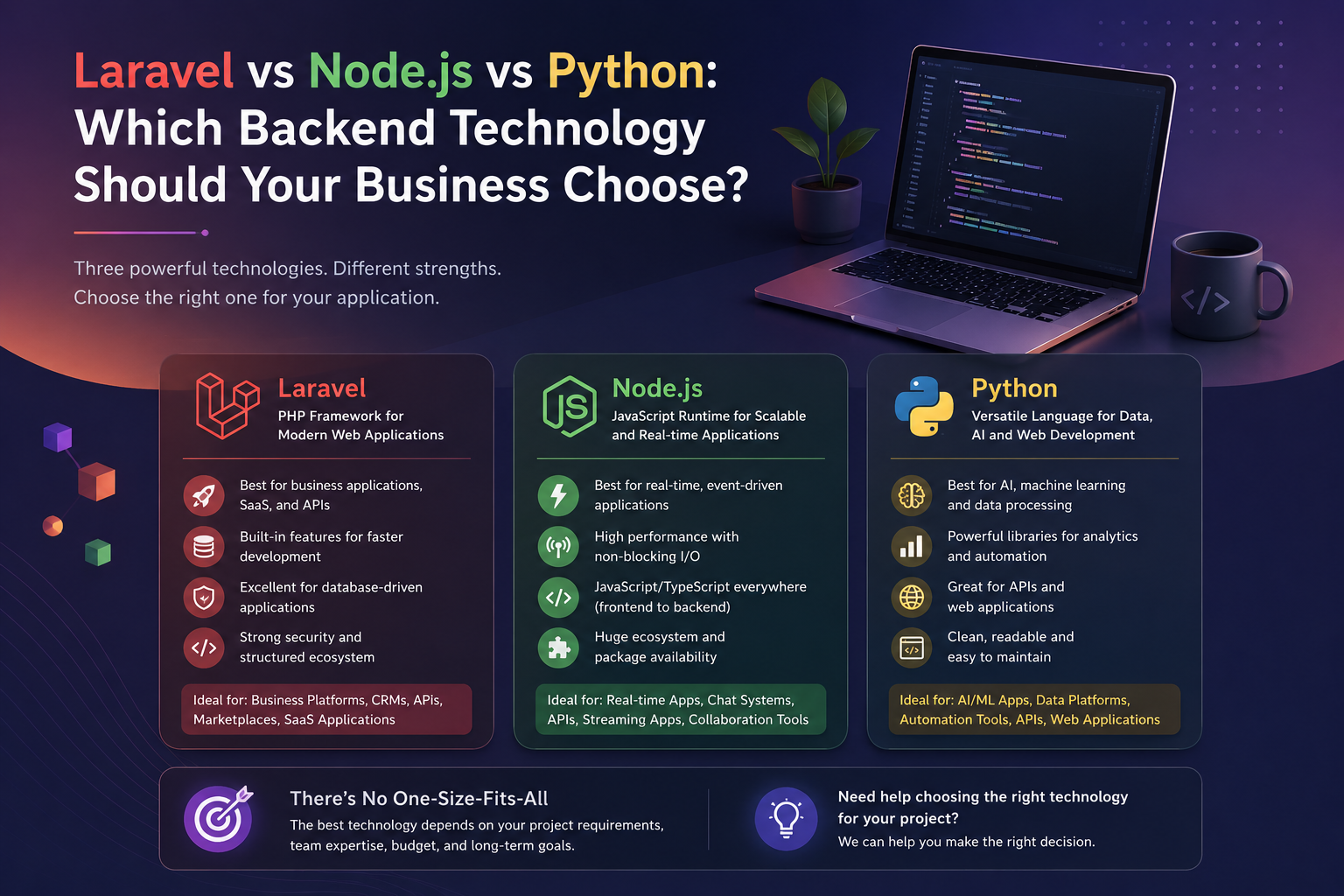
Laravel vs Node.js vs Python: Which Backend Technology Should Your Business Choose?
Choosing a backend for a new application isn't as simple as picking the technology with the most popularity.
If you're building a business application, SaaS product, marketplace, mobile app, or AI platform, the backend will influence how the product is developed, maintained, scaled, and extended later.
Three names come up frequently: Laravel, Node.js, and Python.
All three can power production applications. The question is not which one is "the best." The better question is which one makes sense for the product you're actually building.
A CRM doesn't have the same requirements as a real-time collaboration platform. An AI product doesn't have the same backend needs as an e-commerce application.
That's why the decision should start with the product, not the programming language.
Laravel vs Node.js vs Python at a Glance
FactorLaravelNode.jsPythonLanguagePHPJavaScript / TypeScriptPythonBest known forBusiness applications and web platformsAPIs, real-time and event-driven applicationsAI, data, automation and backend systemsDevelopment speedFastFastFastAPI developmentExcellentExcellentExcellentReal-time applicationsGood with suitable architectureExcellent fitGood with suitable frameworksAI / machine learningPossiblePossibleStrong ecosystemDatabase-driven applicationsExcellentExcellentExcellentScalabilityStrongStrongStrongBest fitSaaS, CRM, business systems, APIsReal-time apps, APIs, event-driven systemsAI, data processing, automation and APIs
These aren't hard boundaries.
A good development team can use any of these technologies to build a wide range of applications. What changes is how naturally each technology fits a particular problem.
What Is Laravel?
Laravel is a PHP framework designed for building modern web applications and backend systems.
One of its biggest strengths is that it gives developers a structured way to handle many of the things business applications commonly need.
That includes:
- Authentication
- Routing
- Database operations
- APIs
- Queues
- Background jobs
- Caching
- Notifications
- Validation
- Task scheduling
- Testing
This makes Laravel particularly practical for applications with a lot of business logic.
For example, a CRM may need customers, leads, permissions, reports, notifications, workflows, and integrations. A SaaS platform may add subscriptions, teams, billing, APIs, and usage tracking.
Laravel provides a solid foundation for these kinds of systems.
If you're specifically looking for a Laravel development team, Kawach also has a dedicated Laravel / PHP developer service.
What Is Node.js?
Node.js allows JavaScript to run on the server.
This means teams can use JavaScript or TypeScript throughout much of an application instead of switching between completely different programming languages for frontend and backend work.
Node.js is especially interesting when an application handles a large number of simultaneous connections or needs real-time communication.
Typical examples include:
- Chat applications
- Live notifications
- Collaboration platforms
- Real-time dashboards
- Streaming applications
- WebSocket services
- APIs
- Event-driven systems
It also has a large package ecosystem, which gives developers a lot of flexibility when building services.
Kawach provides Node.js developers for businesses that need backend APIs, real-time services, or other Node.js-based applications.
What Is Python?
Python is a general-purpose programming language that is used across web development, automation, data processing, artificial intelligence, and machine learning.
For backend development, frameworks such as Django and FastAPI are commonly used.
But Python's biggest advantage for many modern businesses is its wider ecosystem.
If your product needs:
- Machine learning
- AI
- Data processing
- Predictive analytics
- Computer vision
- Natural language processing
- Automation
Python becomes particularly useful.
That's why an AI-powered business application might use Python for its AI services while using another technology for the main application.
Kawach also provides Python developers for backend services, data pipelines, and machine-learning integrations.
Laravel vs Node.js vs Python: Which Is Faster?
This is probably one of the most searched questions, but it doesn't have a simple answer.
The performance of a real application depends on much more than the programming language.
Database queries, caching, infrastructure, application architecture, APIs, background jobs, third-party services, and code quality can all have a significant effect.
For example, a badly optimized database query can make an otherwise well-designed application slow regardless of whether it was built with Laravel, Node.js, or Python.
Laravel can be very productive for database-heavy business applications.
Node.js has a strong fit for I/O-heavy and event-driven workloads.
Python can be highly effective for data-intensive and AI-related applications.
So rather than asking which technology is the fastest in theory, ask which one allows your team to build the required system efficiently and maintain it properly.
Which Is Better for API Development?
All three are capable API technologies.
Laravel works particularly well for business APIs where authentication, permissions, database operations, queues, and application logic are important.
Node.js is a natural choice for JavaScript and TypeScript teams and works well for APIs that need to handle many concurrent connections.
Python frameworks such as FastAPI and Django are useful when an API needs to work closely with data processing, automation, or AI services.
If your application depends heavily on external systems, the quality of the API architecture may matter more than the language itself.
For example, you may need to connect:
- Payment gateways
- CRM systems
- Accounting software
- Mobile applications
- Internal business systems
- Cloud services
- AI services
In those situations, good API design and integration planning are essential.
Kawach also provides custom API development for businesses that need REST APIs, GraphQL APIs, or third-party integrations.
Which Is Better for Real-Time Applications?
Real-time applications have different requirements from traditional business websites.
If users need information to appear immediately without refreshing the page, you may need WebSockets or another real-time communication architecture.
Think about:
- Live chat
- Real-time notifications
- Collaborative editing
- Live tracking
- Real-time dashboards
- Support systems
Node.js is often a natural fit for these types of workloads because its event-driven architecture works well with many concurrent connections.
Laravel can also support real-time functionality when the application is designed appropriately.
Python can handle real-time applications too, although the best approach depends on the framework and overall architecture.
The important thing is not to choose a backend simply because it has "real-time" in its feature list. Look at how the entire application needs to communicate.
Which Is Better for AI and Machine Learning?
For AI and machine learning, Python is usually the most practical starting point.
Its ecosystem is particularly strong around:
- Machine learning
- Deep learning
- Data science
- Natural language processing
- Computer vision
- Data analysis
But there's no rule saying an entire application has to be written in Python just because it uses AI.
A business platform could use Laravel for the main application and Python for an AI service.
For example:
Laravel → API → Python AI service
Laravel could handle:
- Users
- Authentication
- Permissions
- Billing
- Business workflows
- Dashboards
- Administration
Python could handle:
- Model inference
- Data processing
- Recommendations
- Classification
- AI automation
This kind of separation can make sense when each part of the application has different technical requirements.
Which Is Better for SaaS Development?
Laravel, Node.js, and Python can all be used to build SaaS products.
For a typical SaaS platform, you may need:
- User accounts
- Organizations or teams
- Roles and permissions
- Subscription billing
- Dashboards
- Notifications
- APIs
- Reports
- Background jobs
Laravel is often a practical choice for this type of database-driven business software.
Node.js becomes particularly attractive when real-time communication is an important part of the product.
Python becomes especially useful when AI, machine learning, analytics, or data processing is central to the SaaS product.
The architecture should follow the product.
If you're building a complete SaaS product rather than simply an API, Kawach's custom software development services can cover the broader application rather than only the backend layer.
Which Is Better for Startups?
Startups usually don't need the most complicated architecture possible.
They need to get the first useful version of the product into users' hands, learn from those users, and improve it.
That's why the development team matters more than chasing the latest technology.
A startup building a standard business SaaS might be perfectly comfortable with Laravel.
A startup building a real-time collaboration product may lean toward Node.js.
A company building an AI-first product may make Python an important part of the stack.
The best choice is usually the technology your team can develop quickly without creating unnecessary technical debt.
Which Is More Scalable?
Laravel, Node.js, and Python can all be used to build scalable applications.
But "scalable" can mean different things.
One application might need to support thousands of concurrent users.
Another might process millions of records every day.
Another might need to run expensive machine-learning workloads.
Another might simply need to handle a rapidly growing number of API requests.
The architecture needs to reflect the actual problem.
As applications grow, developers may need to consider:
- Database optimization
- Caching
- Queues
- Background workers
- Load balancing
- Horizontal scaling
- CDN
- Cloud infrastructure
- Monitoring
- Service separation
This is where DevOps becomes important.
A good development stack still needs a reliable deployment and infrastructure strategy behind it. Kawach's DevOps and platform engineering services cover areas such as CI/CD, infrastructure as code, containerization, deployment automation, security, and cloud infrastructure.
Which One Costs Less?
It's tempting to compare the three technologies by developer hourly rates.
That's not the best way to estimate the actual cost.
The bigger factors are usually:
- Project complexity
- Development time
- Team size
- Developer experience
- Infrastructure
- Testing
- Third-party services
- Maintenance
- Changes after launch
Suppose one technology takes slightly longer to develop but is easier for your team to maintain.
That may be a better financial decision than choosing a technology simply because the initial development estimate is lower.
The technology is only one part of the software budget.
Laravel vs Node.js vs Python: Where Each Makes Sense
Laravel is a good fit for:
- CRM systems
- Business management software
- SaaS platforms
- E-commerce backends
- Customer portals
- Booking platforms
- Admin systems
- REST APIs
- Workflow automation
- Database-driven applications
Node.js is a good fit for:
- Real-time applications
- Chat platforms
- Collaboration tools
- Notification systems
- Event-driven services
- High-concurrency APIs
- Streaming applications
- JavaScript / TypeScript-heavy teams
Python is a good fit for:
- AI applications
- Machine learning
- Data processing
- Analytics
- Automation
- Recommendation systems
- Computer vision
- Natural language processing
- Data-heavy backend systems
These categories overlap. The same product can reasonably use more than one of them.
Can Laravel, Node.js and Python Work Together?
Yes, and this is sometimes the better architecture.
Imagine a business platform that needs a traditional backend plus an AI recommendation system.
You could use Laravel for the core business application and Python for the machine-learning component.
Or you could use Node.js for a real-time service while another backend handles the main business logic.
The services can communicate through APIs.
That doesn't mean every project should use multiple languages.
Adding more technologies also means adding more deployment, monitoring, testing, and maintenance requirements.
The goal should be to use multiple technologies only when they solve a real problem.
What Should You Consider Before Choosing?
Before selecting the backend, answer a few practical questions.
What are you actually building?
A CRM, marketplace, SaaS platform, AI product, and real-time collaboration application don't have the same technical requirements.
Start there.
What does version one need?
Don't design a system for millions of users if you're still validating whether people want the product.
Build a sensible first version and leave room for growth.
Does the product depend on AI?
If AI is a core part of the application, Python will likely be useful somewhere in the architecture.
Does the application need real-time communication?
If users need live updates, chat, tracking, or collaboration, your real-time architecture should be considered from the beginning.
What does your development team already know?
This is often overlooked.
A technology that looks excellent on paper isn't necessarily a good choice if your team has little experience with it.
What integrations are required?
List your integrations before development starts.
Payment systems, CRMs, accounting platforms, cloud services, AI APIs, email providers, mobile applications, and internal systems can all influence the architecture.
Who will maintain the application?
Think beyond launch.
Someone will need to fix bugs, upgrade dependencies, monitor the infrastructure, improve performance, and develop new features.
The technology should be something your team can support for years.
Don't Choose a Backend Based on a Benchmark Alone
A benchmark can tell you something about a technology under a particular test.
It can't tell you what your actual business application will cost to build or how easy it will be to maintain.
A production application has users, databases, authentication, permissions, APIs, files, queues, integrations, monitoring, deployment pipelines, and business rules.
Those things all matter.
A well-architected Laravel application can be a better business decision than a poorly designed application written in a theoretically faster technology.
The same applies to Node.js and Python.
What Does Kawach Use?
Kawach works across multiple technologies rather than forcing every project into one stack.
The current technology offering includes Laravel, Node.js, Python, React, Vue.js, Flutter, React Native, AWS, Docker, MySQL, PostgreSQL, Redis, and TypeScript.
That makes it possible to select the stack based on the requirements of the project rather than trying to make every application fit the same architecture.
For businesses that need broader application development, Kawach also provides web and mobile application development alongside backend development.
Final Verdict: Laravel, Node.js or Python?
There isn't a universal winner.
Choose Laravel when you're building a structured business application, SaaS platform, CRM, customer portal, API, or another system with substantial business logic and database operations.
Choose Node.js when real-time communication, event-driven workloads, concurrent connections, or a JavaScript/TypeScript-heavy environment are important parts of the product.
Choose Python when AI, machine learning, data processing, analytics, or automation are central to what you're building.
And sometimes the answer is more than one technology.
The most important decision isn't which framework is trending this year. It's whether the technology fits your product, your development team, your budget, and the direction you expect the business to take.
If you're planning a new application and aren't sure which backend makes sense, start with the requirements first. The technology decision becomes much easier once the actual problem is clear.
Need Help Choosing the Right Backend?
Kawach Technology helps businesses design and develop custom applications using technologies such as Laravel, Node.js, Python, React, Vue, Flutter, and React Native.
Whether you are building a new SaaS product, modernizing an existing application, adding AI capabilities, or developing a custom business platform, the architecture should be selected around your requirements.
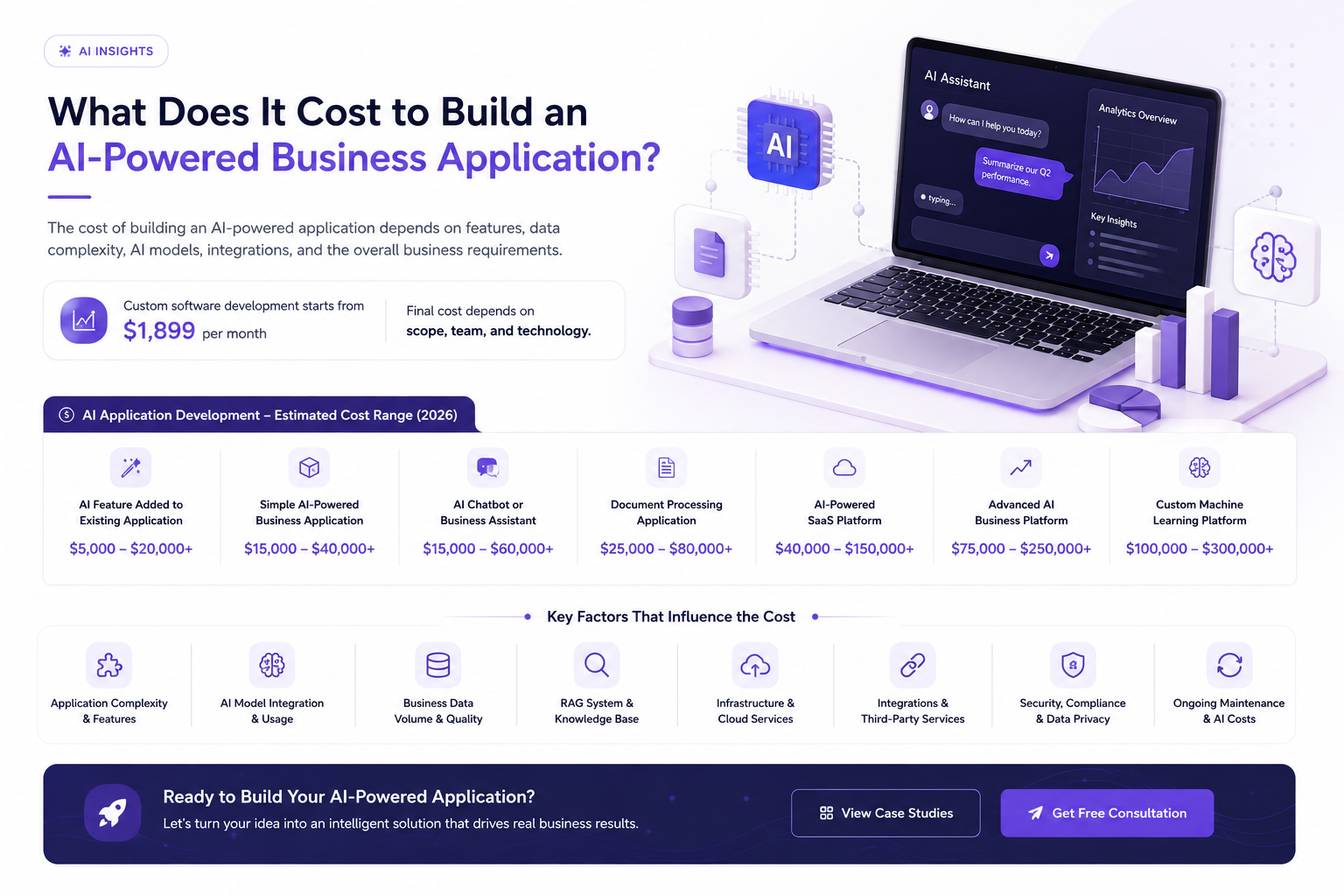
For businesses looking for a flexible development model, Kawach custom software development starts at $1,899 per month.
The goal isn't to choose the most popular technology.
It's to build software that works well today and gives your business room to grow tomorrow.
Be the first to comment.