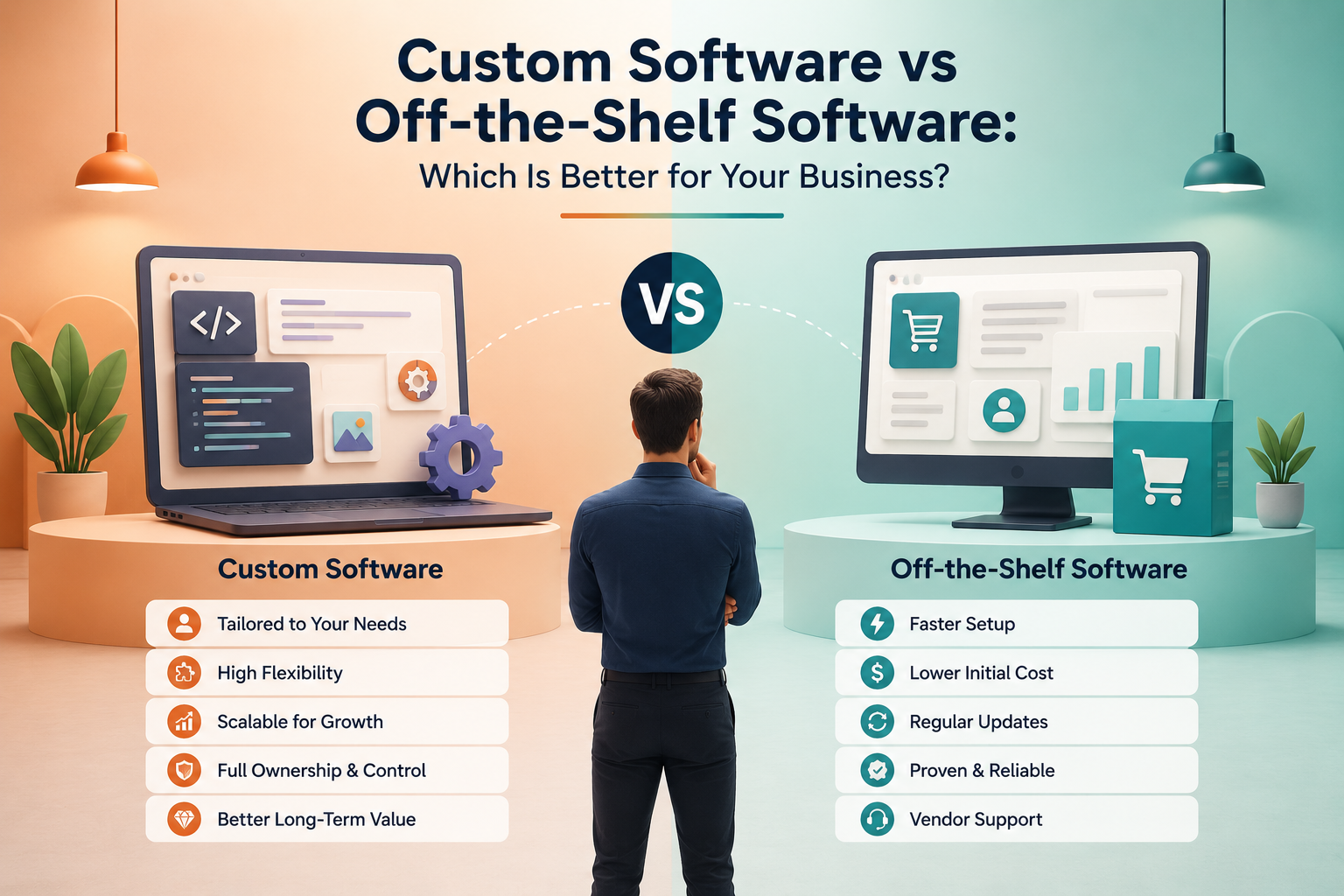
Custom Software vs Off-the-Shelf Software: Which Is Better for Your Business?
Choosing software for your business can look simple at first. Find a product, check the price, see whether it has the features you need, and start using it.
But that approach doesn't always work.
As a business grows, its software requirements usually become more specific. You may need a particular approval process, a custom dashboard, integration with your existing systems, different user permissions, or automation that isn't available in the software you're currently using.
That's when the question becomes important:
Should you continue with off-the-shelf software, or should you invest in custom software?
There isn't one answer that works for every business. Off-the-shelf software can be the right choice when your requirements are straightforward. Custom software can make more sense when your business depends on workflows and functionality that existing products cannot provide.
In this guide, we'll compare custom software vs off-the-shelf software based on cost, development time, customization, scalability, integrations, security, ownership, and long-term flexibility.
What Is Off-the-Shelf Software?
Off-the-shelf software is a ready-made product that is developed for a large number of businesses or users.
You don't build the application yourself. Instead, you purchase a license or subscribe to a service and configure it for your business.
Examples include software for:
- Accounting
- CRM
- Project management
- Employee management
- Invoicing
- Marketing
- Customer support
- Communication
- Inventory management
- Business analytics
The main attraction is convenience.
You can generally sign up, configure the system, add your employees, import your data, and start working without waiting for a development team to build the application.
For a company with standard requirements, that's a major advantage.
What Is Custom Software?
Custom software is developed specifically for a business, product, or particular group of users.
Instead of choosing from the features an existing product provides, the business decides what the software needs to do.
For example, a company might want a custom platform that combines:
- Customer management
- Internal operations
- Billing
- Reporting
- Employee workflows
- Third-party integrations
- Mobile access
- Automated notifications
Rather than managing several disconnected applications, the business can build one platform around its actual workflow.
Custom software can also be developed as a new SaaS product, customer portal, marketplace, mobile application, internal business system, or enterprise platform.
Custom Software vs Off-the-Shelf Software: Quick Comparison
The simplest way to understand the difference is to compare the two options side by side.
FactorCustom SoftwareOff-the-Shelf SoftwareInitial costUsually higherUsually lowerDevelopment timeLongerFaster to startCustomizationVery highLimited to available featuresScalabilityDesigned around requirementsDepends on providerIntegrationsCan be built specificallyDepends on available integrationsOwnershipGreater controlUsually vendor-controlledUpdatesControlled by business/developerControlled by vendorSecurityCan be designed for requirementsProvider-managedUser experienceDesigned for your usersGenericLong-term flexibilityHighDepends on vendorVendor dependencyCan be lowerUsually higherBest forUnique or complex requirementsStandard business processes
The table doesn't mean that custom software is always better. It simply highlights where the two approaches are different.
The right choice depends on what your business actually needs.
Why Businesses Choose Off-the-Shelf Software
There is a reason ready-made software is so popular. In many cases, it solves a problem without requiring a business to build anything.
You Can Get Started Quickly
If you need a CRM, accounting system, project management tool, or helpdesk, there are already hundreds of products available.
You can choose one, configure it, and begin using it.
That's very different from custom development, where you first need to define the requirements, design the product, develop it, test it, and deploy it.
The Initial Cost Is Usually Lower
Most off-the-shelf products use a subscription model.
You might pay a monthly fee based on the number of users or the features you need.
For a small business with straightforward requirements, this can be much more affordable than commissioning a new application.
Someone Else Handles the Product
With a commercial software product, the vendor is generally responsible for maintaining the core application.
Updates, bug fixes, infrastructure, documentation, and new features are normally handled by the provider.
This is useful for businesses that don't want to manage their own software development team.
The Product Has Already Been Tested
Established software products have usually been used by many customers before you adopt them.
You aren't starting with an untested application.
That can reduce some of the risks associated with developing a new system from scratch.
Where Off-the-Shelf Software Can Become a Problem
The same thing that makes ready-made software convenient can also become its biggest limitation.
It wasn't built specifically for your business.
You May Have to Change Your Workflow
Imagine your company has a five-step approval process, but the software only supports three steps.
You have two choices: change your process or find a workaround.
Over time, these workarounds can become frustrating for employees.
The software is supposed to support the business, but the business ends up adjusting itself around the software.
You May Pay for Features You Don't Need
Most commercial applications are designed to serve a broad market.
That means they often contain dozens of features that aren't relevant to your company.
At the same time, the one feature you really need may not exist.
This is one of the common frustrations businesses experience when they outgrow generic software.
Integrations Can Be Limiting
Modern businesses rarely operate with one application.
You might need your software to communicate with:
- CRM systems
- Payment gateways
- Accounting platforms
- ERP systems
- Internal databases
- Mobile applications
- Marketing tools
- Communication platforms
- Cloud services
- AI services
If the software provider doesn't support the integration you need, you may have to use another tool or develop a workaround.
You're Dependent on the Vendor
When you use an off-the-shelf product, the vendor controls important parts of the product.
They decide:
- What features are added
- What features are removed
- How pricing changes
- Which integrations are supported
- How the product evolves
- How long older versions are supported
If your business becomes heavily dependent on the product, moving away from it later can be difficult.
Why Businesses Choose Custom Software
Custom software takes more effort at the beginning, but the trade-off is control.
The Software Can Match Your Workflow
A custom application can be designed around the way your company actually works.
For example, if your sales team follows a specific process from lead qualification to contract approval, the application can be designed around that process.
Employees don't have to keep finding ways around the software.
You Decide What Gets Built
With custom development, you can prioritize features based on business value.
You may decide that your first version needs:
- Customer management
- Employee accounts
- Role-based permissions
- Reporting
- Notifications
- Payment processing
Other features can be added later.
This is particularly useful when building an MVP or gradually expanding a business platform.
Integrations Can Be Designed Around Your Business
Custom development gives you more control when your application needs to communicate with other systems.
For example, you could build integrations with payment providers, CRM platforms, accounting software, cloud storage, internal systems, or AI services.
Instead of asking whether an existing product supports your workflow, you can design the integration around your requirements.
You Have More Control as the Business Grows
A software product that works for 20 employees may not work the same way for 500 employees.
Growth can bring new requirements around:
- Performance
- Database architecture
- User permissions
- Reporting
- Security
- Automation
- Infrastructure
- Integrations
A custom application can be designed with those future requirements in mind.
Custom Software Isn't Automatically the Better Choice
It's easy to read about the benefits of custom software and conclude that every business should build its own system.
That's not true.
If an existing product does exactly what you need, paying to develop another one may not make financial sense.
For example, suppose a small business needs basic invoicing and accounting.
If an established accounting platform already handles everything the business needs, developing a custom accounting system would probably add unnecessary cost and complexity.
Custom development becomes more attractive when the software itself needs to provide something that existing products cannot.
What About Cost?
Cost is usually one of the first things businesses consider.
Off-the-shelf software generally has a lower initial price because the product has already been developed and the development cost is distributed across many customers.
Custom software requires a development team and therefore involves a larger initial investment.
But comparing only the initial price can be misleading.
Consider a business that pays for five different software subscriptions because no single product handles its complete workflow.
It may also pay for:
- Additional users
- Premium integrations
- Custom configuration
- Data migration
- Separate reporting tools
- Third-party automation
The monthly costs can add up.
On the other hand, a custom platform may require more investment initially but could bring several workflows into one system.
The important question isn't simply:
"Which option is cheaper?"
It's:
"Which option provides the best value for the way my business operates?"
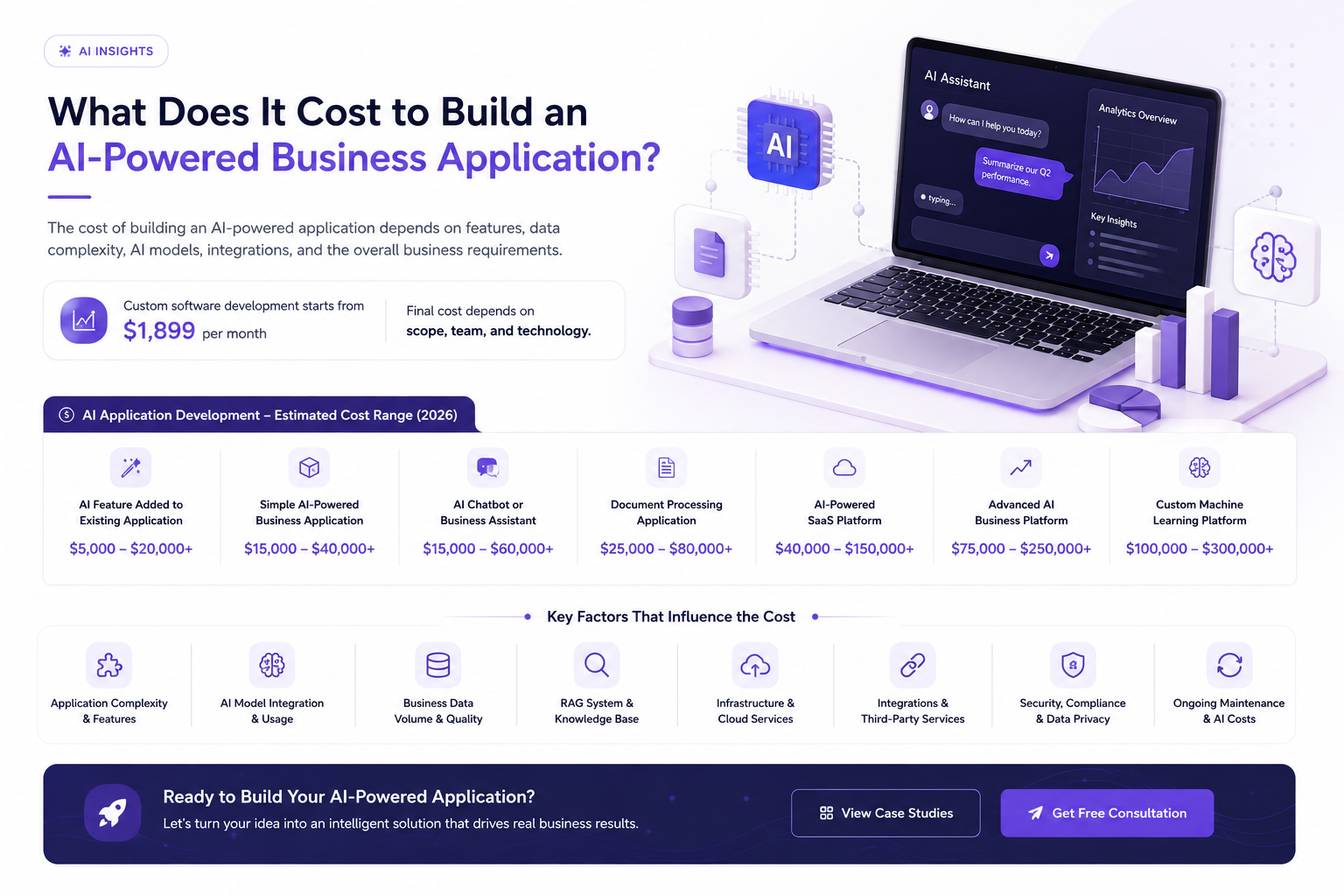
How Much Does Custom Software Development Cost?
There is no fixed price for custom software.
The cost depends on the size and complexity of the application.
Some of the biggest factors include:
- Number of features
- UI/UX requirements
- Web or mobile platforms
- Backend architecture
- Database requirements
- Third-party integrations
- Security requirements
- AI functionality
- Testing
- Cloud infrastructure
- Development team size
- Ongoing maintenance
A small internal business application may have a very different budget from a multi-tenant SaaS platform or enterprise application.
For businesses that want to spread development costs over time, Kawach Technology offers custom software development starting at $1,899 per month.
This monthly model can be useful for startups and growing businesses that want access to a development team without making a large one-time investment at the beginning.
Custom Software vs Off-the-Shelf: Which One Should You Choose?
A simple way to approach the decision is to look at your requirements.
Choose Off-the-Shelf Software If:
An existing product may be the better option when:
- Your requirements are fairly standard.
- You need a solution quickly.
- Your budget is limited.
- An existing product already solves the majority of your problems.
- You don't need much customization.
- Your required integrations are already available.
- You don't need control over the product roadmap.
In these circumstances, building custom software may create more work than value.
Choose Custom Software If:
Custom development becomes more attractive when:
- Your business has unique processes.
- Existing products force you to use workarounds.
- You need functionality that isn't available elsewhere.
- You need several systems to work together.
- Your application needs to scale with your business.
- Software is an important part of your competitive advantage.
- You need complete control over the user experience.
- You are building a SaaS product.
- You want to automate a complicated process.
- Your existing software has become difficult to maintain.
What If You Need Both?
You don't always have to choose one approach.
A hybrid model can work very well.
For example, a company might continue using an established accounting platform while building a custom customer portal.
The customer portal can communicate with the accounting system through APIs while the company's unique processes remain inside the custom application.
Another company could use an existing CRM while building custom software for its internal operations.
This approach allows businesses to avoid rebuilding functionality that already works while investing in the areas where customization actually matters.
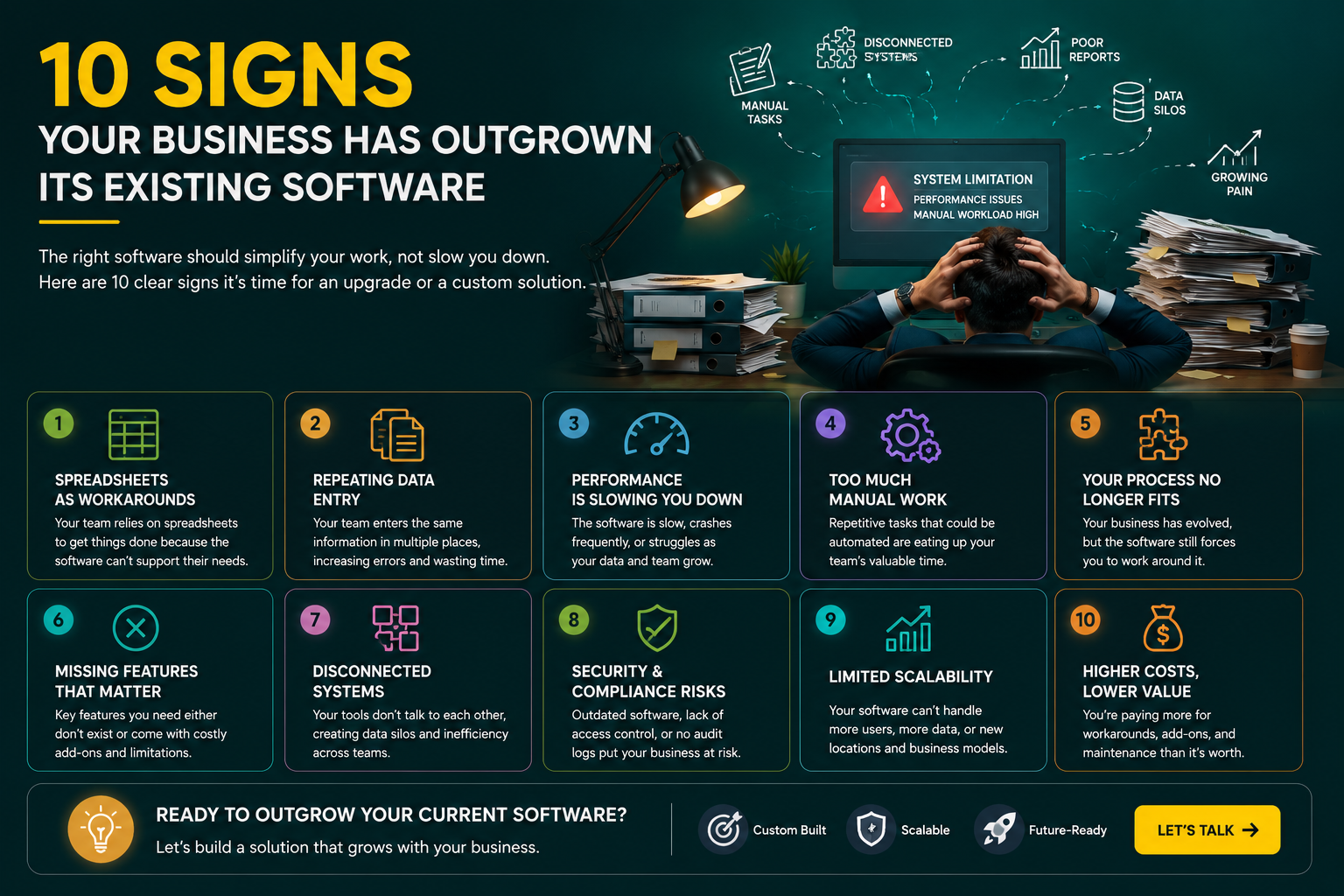
Signs You've Outgrown Off-the-Shelf Software
Sometimes the decision becomes easier because the existing software starts causing problems.
You may have outgrown your current solution if:
Your Team Uses Spreadsheets to Fill Software Gaps
If employees constantly export information into spreadsheets because the software doesn't provide the required workflow or report, that's worth examining.
Employees Have Created Manual Workarounds
Multiple manual steps to accomplish something that should be automated can indicate that the software no longer fits your operation.
You're Paying for Multiple Systems That Don't Work Together
If employees have to move information manually between several applications, a more integrated solution may be worth considering.
Your Business Has Changed
The software that worked when your company had 10 employees may not be appropriate after significant growth.
New departments, customers, products, locations, and processes can create requirements that weren't present when the software was first selected.
The Software Limits Your Product
For SaaS businesses especially, this is an important warning sign.
If an existing platform prevents you from introducing features that differentiate your product, custom development may be necessary.
What Does Custom Software Development Involve?
Custom software isn't simply writing code.
A successful project usually involves several stages.
1. Requirements and Discovery
The development team first needs to understand the business problem.
This includes identifying users, workflows, features, integrations, and technical requirements.
2. Planning and Architecture
The team determines how the application should be structured.
This may include database architecture, APIs, authentication, permissions, infrastructure, and scalability considerations.
3. UI/UX Design
The interface and user experience are designed around the people who will actually use the software.
4. Development
Developers build the frontend, backend, database, APIs, integrations, and required functionality.
5. Testing
The application needs to be tested before release.
This can include functional testing, API testing, regression testing, performance testing, and security testing.
6. Deployment
The application is deployed to the appropriate production infrastructure.
7. Maintenance
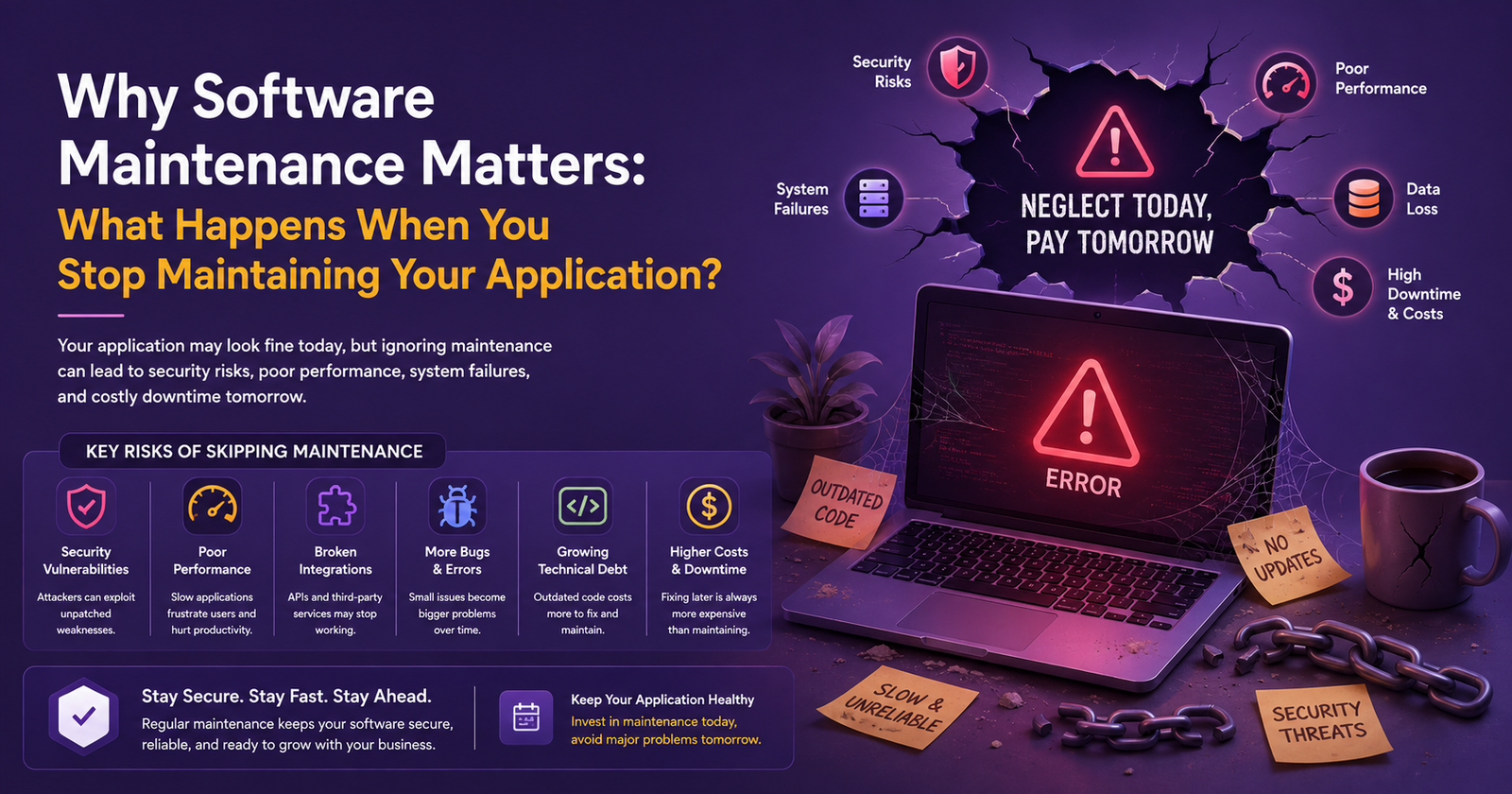
Software doesn't stop needing attention after launch.
Security updates, bug fixes, dependency updates, performance improvements, monitoring, and new features may all be required over time.
Why Kawach Technology for Custom Software Development?
Kawach Technology works with businesses that need software built around their specific requirements rather than a generic product.
Our capabilities include:
- Custom software development
- Web application development
- Mobile application development
- SaaS development
- AI-powered applications
- API development
- Business automation
- Cloud and DevOps
- QA and testing
- Application maintenance
- Software modernization
The development approach can be adapted to the size and stage of your business.
For companies looking for a flexible monthly engagement, Kawach custom software development starts at $1,899 per month.
That gives startups and growing businesses another option besides hiring and managing a large internal development team or committing to a large one-time development budget.
Frequently Asked Questions
Is custom software better than off-the-shelf software?
It depends on your requirements. Off-the-shelf software is often the better choice when your business has standard needs and wants to get started quickly. Custom software is more suitable when your workflows, integrations, scalability, or functionality require a solution built specifically for your business.
Is custom software more expensive?
Custom software usually requires a larger initial investment because it has to be designed and developed specifically for your business. However, the long-term cost should also consider subscriptions, integrations, user-based pricing, productivity, maintenance, and the value the software provides.
Can a small business use custom software?
Yes. A small business doesn't necessarily need to build a large enterprise application. It can start with an MVP or a focused internal application and add functionality as the business grows. Kawach Technology offers custom software development starting at $1,899 per month.
How long does custom software take to build?
The timeline depends on the scope. A small application can take a few months, while a complex SaaS, enterprise, healthcare, or AI-powered platform may take significantly longer.
Can custom software integrate with existing software?
Yes. Custom applications can integrate with other systems using APIs, webhooks, databases, and other integration methods, depending on what the existing systems support.
Should I replace my existing software?
Not necessarily. First identify what isn't working. If configuration or an integration can solve the problem, replacing the entire system may not be necessary. If the limitations are fundamental and are affecting your operations or growth, custom development may be worth considering.
Can custom software be developed gradually?
Yes. Many businesses start with the most important features and add additional functionality over time. This approach can help control costs and allow the business to learn from real users before investing in advanced features.
Final Thoughts
The choice between custom software and off-the-shelf software isn't really about which one is universally better.
It's about which one fits your business better.
If you have standard requirements and need software quickly, an existing product can save time and money.
If your business has unique workflows, complicated integrations, specialized requirements, or a product that needs to evolve with your company, custom software may be a better long-term investment.
And there is always a middle ground. You can continue using existing products for common functions while building custom software around the areas that make your business different.
Before making the decision, look at your current workflow, the problems your team faces, the software you already use, and where you expect the business to be in the next few years.
That will give you a much better answer than simply comparing the price of a subscription with the price of software development.
If you are considering building a custom application, Kawach Technology offers custom software development starting at $1,899 per month.
Have a software idea or an existing system that isn't working the way you need? Talk to Kawach Technology about your requirements and find out whether custom development is the right approach for your business.
Be the first to comment.