Executive Summary
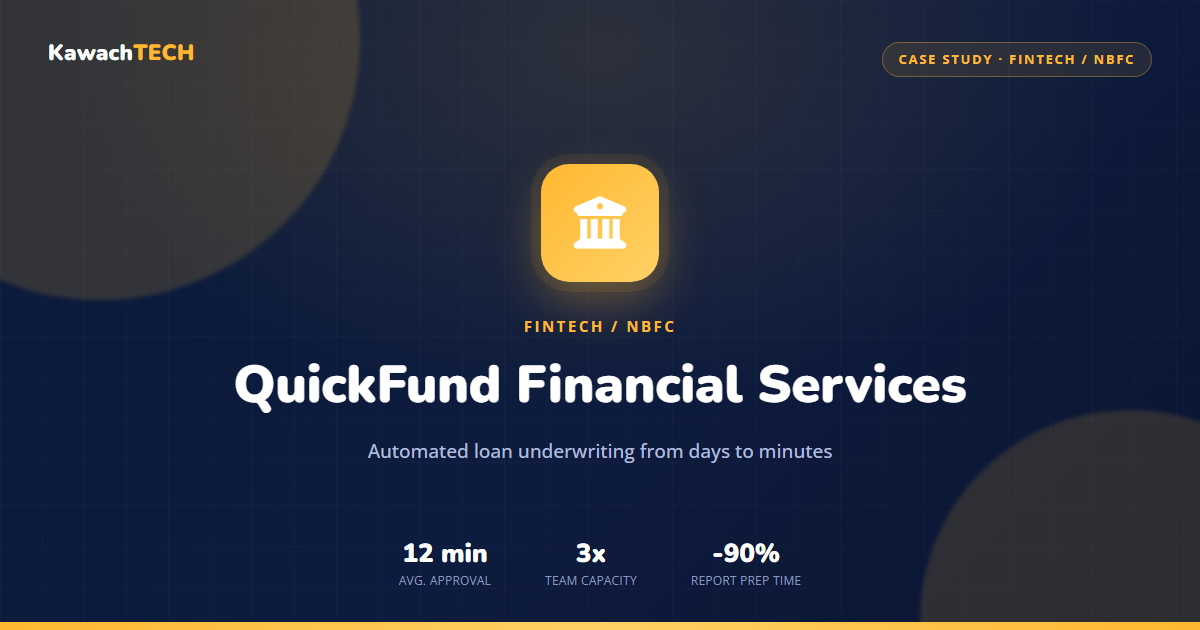
How Kawach Technology built an automated loan origination and credit scoring system for QuickFund, cutting approval time from days to minutes.
- 5-7 days → 12 min loan approval time
- < 3 min kyc verification time
- +3x applications/day underwriting team capacity
- -90% regulatory report prep time
Project fact sheet
| Client | QuickFund Financial Services |
| Industry | FinTech / NBFC Lending · FinTech Software Development |
| Location | Pune, India |
| Business size | Mid-size NBFC, ₹200 Cr+ loan book |
| Business model | Digital Lending / NBFC |
| Project duration | 10 months |
| Core technology | Laravel, Python, PostgreSQL, AWS, Aadhaar eKYC API, ML |
The Challenge
QuickFund Financial Services had grown its loan book past ₹200 crore largely on the strength of its underwriting team's judgment — but that same manual process had become the ceiling on how much further the business could grow. Loan applications were reviewed by hand, and even straightforward cases took five to seven business days to get a decision, mostly because underwriters were manually cross-referencing bureau reports, income documents, and bank statements one application at a time.
KYC verification relied on physically collected documents, which meant delays before an application could even enter the review queue. Worse, credit risk assessment varied meaningfully between underwriters — there was no standardized, data-driven scoring model, just individual judgment shaped by each underwriter's own experience. That inconsistency was a real risk, not just an efficiency problem.
Leadership had no real-time view into the health of the loan book. NPAs, disbursement trends, and collections were compiled by hand into monthly reports, meaning problems could go unnoticed for weeks. And every quarter, the finance team spent days manually assembling RBI-mandated regulatory reports from a patchwork of spreadsheets — time that could have gone toward actually managing risk instead of documenting it after the fact.
Key problems identified
| # | Problem |
|---|---|
| 01 | Loan applications were reviewed manually by underwriters, taking 5-7 business days per decision even for straightforward cases. |
| 02 | KYC verification relied on physically collected documents, creating bottlenecks and a poor applicant experience. |
| 03 | Credit risk assessment varied significantly between underwriters, since there was no standardized, data-driven scoring model. |
| 04 | Leadership had no real-time dashboard of loan book health — NPAs, disbursement trends, and collections were compiled manually every month. |
| 05 | RBI-mandated regulatory reports were assembled by hand from multiple spreadsheets every quarter, consuming days of the finance team's time. |
Goals & Objectives
| Objective | What success meant |
|---|---|
Automate Underwriting |
Replace manual document review with an automated, data-driven credit decisioning engine. |
Speed Up KYC |
Verify applicant identity digitally in minutes instead of days. |
Standardize Risk Scoring |
Apply a consistent, auditable credit scoring model to every application. |
Give Leadership Real-Time Visibility |
Replace manual monthly reporting with a live portfolio health dashboard. |
The Solution
Because this was a regulated lending business, we started with QuickFund's risk and compliance teams, not the engineering backlog — working through RBI's digital lending guidelines together before designing a single workflow. That sequencing mattered: the credit scoring model we eventually built came directly from translating QuickFund's own underwriters' existing manual assessment logic into a structured, data-driven scoring system, rather than importing a generic off-the-shelf model.
The platform integrates Aadhaar and PAN verification APIs so identity checks that used to take days now complete in minutes, alongside a hybrid rules-based and machine-learning credit scoring engine, e-signature for loan agreements, a real-time portfolio dashboard, and automated RBI regulatory reporting generated directly from live loan book data.
We didn't let the automated scoring engine make a single live decision until it had earned that trust: for six weeks, it ran in parallel with manual underwriting, and we compared every automated recommendation against what an experienced underwriter actually decided. Only once that comparison showed consistent accuracy did QuickFund's compliance team sign off on a phased go-live — starting with smaller loan tickets and expanding to larger ones only after the system built a track record.
The result respects a principle QuickFund was firm about from day one: automation should handle the clear-cut cases, and route anything ambiguous to a human underwriter rather than force a decision either way.
Modules delivered
| Module | Purpose |
|---|---|
Digital Loan Origination |
End-to-end online application flow from form submission through disbursement, replacing the paper-based process. |
Automated KYC Verification |
Integrated Aadhaar and PAN verification APIs to confirm applicant identity in minutes. |
Credit Scoring Engine |
A rules-based and machine-learning hybrid model that scores applications using bureau data, income signals, and repayment history. |
E-Sign Loan Agreements |
Legally compliant digital signing of loan agreements, eliminating physical paperwork and courier delays. |
Portfolio Dashboard |
Real-time visibility into disbursements, collections, and NPA trends for leadership and the risk team. |
Regulatory Reporting |
Automated generation of RBI-mandated reports directly from live loan book data. |
Key Features
Automated Underwriting
Data-driven credit decisions in minutes instead of days.
Digital KYC
Aadhaar and PAN verification completed in under 3 minutes.
E-Sign Agreements
Legally compliant digital signing, no physical paperwork.
Real-Time Portfolio Dashboard
Live visibility into disbursements, collections, and NPAs.
Automated Regulatory Reports
RBI-mandated reports generated directly from live data.
Technology Stack
| Layer | Technologies |
|---|---|
| Backend | |
| Credit Scoring | |
| Integrations |
Aadhaar eKYC API
PAN verification API
e-Sign gateway
|
| Infrastructure |
Delivery Process
-
1
Regulatory & Risk Discovery
Worked closely with QuickFund's risk and compliance teams to understand RBI lending guidelines before designing any workflow.
-
2
Credit Model Design
Collaborated with QuickFund's underwriters to translate their existing manual assessment logic into a structured, data-driven scoring model.
-
3
Core LOS Development
Built the loan origination workflow and KYC integrations first, since every other module depended on a verified applicant record.
-
4
Parallel-Run Validation
Ran the automated scoring engine alongside manual underwriting for 6 weeks, comparing outcomes before trusting it with live decisions.
-
5
Compliance Review & Sign-Off
Had the full system, including data handling and audit logging, reviewed by QuickFund's compliance team before go-live.
-
6
Phased Go-Live
Rolled out automated underwriting for smaller loan tickets first, expanding to larger ticket sizes only after building a track record of accuracy.
Security & Compliance
| Measure | How it was handled |
|---|---|
RBI Lending Guidelines |
The credit decisioning and disclosure workflows were designed in direct consultation with QuickFund's compliance team to align with RBI digital lending guidelines. |
Data Localization & Encryption |
All applicant and financial data is stored on infrastructure within India, encrypted at rest and in transit. |
Audit Trail |
Every underwriting decision, automated or manually reviewed, is logged with a full audit trail for regulatory inspection. |
Consent-Based Data Use |
Applicant data is only used for credit assessment with explicit consent captured during the application flow. |
Results & Impact
Results reported for this project after launch.
Before vs. after
| Before | After |
|---|---|
| 5-7 business days to approve a loan application | ~12 minutes for automated decisions on standard applications |
| Physical KYC document collection | Digital Aadhaar/PAN verification in under 3 minutes |
| Underwriter judgment varied case to case | Standardized, auditable credit scoring for every application |
| Manual monthly portfolio reports | Real-time portfolio dashboard for leadership |
Client Feedback
Lending is a business of trust and speed, and we were struggling on both fronts with a manual process. Kawach didn't just automate our underwriting — they built it in a way our compliance team could actually stand behind. We went from a 5-7 day approval cycle to minutes, without cutting a single corner on due diligence.
Key Achievements
-
Approval Time Cut from Days to Minutes
Straightforward loan applications now receive a decision in about 12 minutes instead of 5-7 business days.
-
3x Underwriting Capacity Without New Hires
The existing underwriting team now handles roughly 3x the application volume by focusing only on edge cases the automated engine flags for review.
-
Passed Compliance Review on First Submission
The new regulatory reporting module passed QuickFund's internal compliance audit on its first submission, with no findings.
Frequently Asked Questions
How did you validate the automated credit scoring model before trusting it with real decisions?
We ran the model in parallel with QuickFund's manual underwriting process for 6 weeks, comparing every automated decision against what an experienced underwriter would have decided, before allowing it to make live decisions.
Does the system still involve human underwriters?
Yes. The automated engine handles clear-cut approvals and rejections, and routes borderline or high-value applications to human underwriters — it's designed to augment the team, not replace judgment on edge cases.
How is applicant data kept compliant with RBI regulations?
All data handling, consent capture, and disclosure workflows were built in direct consultation with QuickFund's compliance team and reviewed against RBI's digital lending guidelines before go-live.
What happens if the automated system is unsure about an application?
Applications that don't clearly meet or fail the scoring criteria are automatically flagged and routed to a human underwriter rather than being auto-approved or auto-rejected.