Executive Summary
How Kawach Technology unified POS, online ordering, and kitchen operations for Bistro Nationale Group across 85 restaurant locations in France.
- -34% aggregator fee spend
- -26% kitchen ticket time
- Days → Minutes menu update rollout time
- +45% first-party order share
Project fact sheet
| Client | Bistro Nationale Group |
| Industry | Restaurant / Food Service |
| Location | Lyon, France · Software development in Europe |
| Business size | 85 restaurant locations across France |
| Business model | Casual Dining Restaurant Chain |
| Project duration | 6 months |
| Core technology | Node.js, React, PostgreSQL, Stripe, AWS, POS Integration APIs |
The Challenge
Bistro Nationale Group grew to 85 locations across France partly through acquiring smaller regional chains, and each acquisition brought its own point-of-sale system along with it. By the time Bistro Nationale came to us, the company was running a patchwork of different POS platforms accumulated over years of independent local decisions — nothing that head office could see or report on consistently.
Online ordering existed only through third-party delivery aggregators charging steep per-order fees, cutting meaningfully into margin on every digital order with no first-party alternative. Inside the kitchens, order tickets still printed on paper, which slowed order flow noticeably during peak dinner service and made it harder to track exactly how long an order had been sitting.
Head office had no real-time visibility into sales or inventory levels across locations, and menu or pricing updates had to be pushed to each location's system individually — a process that could take days to fully roll out chain-wide, during which some locations were selling at old prices while others had already updated.
Key problems identified
| # | Problem |
|---|---|
| 01 | The 85 locations ran a patchwork of different POS systems accumulated over years of independent local decisions. |
| 02 | Online ordering went entirely through third-party delivery aggregators charging steep per-order fees. |
| 03 | Kitchens still relied on printed paper tickets, slowing order flow during peak service. |
| 04 | Head office had no real-time visibility into sales or inventory levels across locations. |
| 05 | Menu and pricing updates had to be manually pushed to each location individually, taking days to roll out chain-wide. |
Goals & Objectives
| Objective | What success meant |
|---|---|
Unify POS Data Chain-Wide |
Give head office one consistent view of sales and inventory across all locations. |
Reduce Aggregator Dependency |
Capture more online orders directly instead of paying steep aggregator commissions. |
Digitize Kitchen Operations |
Replace paper tickets with a faster, clearer digital kitchen display. |
Centralize Menu & Pricing Management |
Roll out menu and price changes chain-wide in minutes, not days. |
The Solution
Rather than ripping out 85 different POS setups at once — a change management nightmare and an unnecessary one — we built a unified data layer that sits above the existing POS hardware wherever possible, normalizing sales and inventory data into one consistent format regardless of which underlying system a given location ran. That data layer is what finally made a real chain-wide dashboard possible for head office.
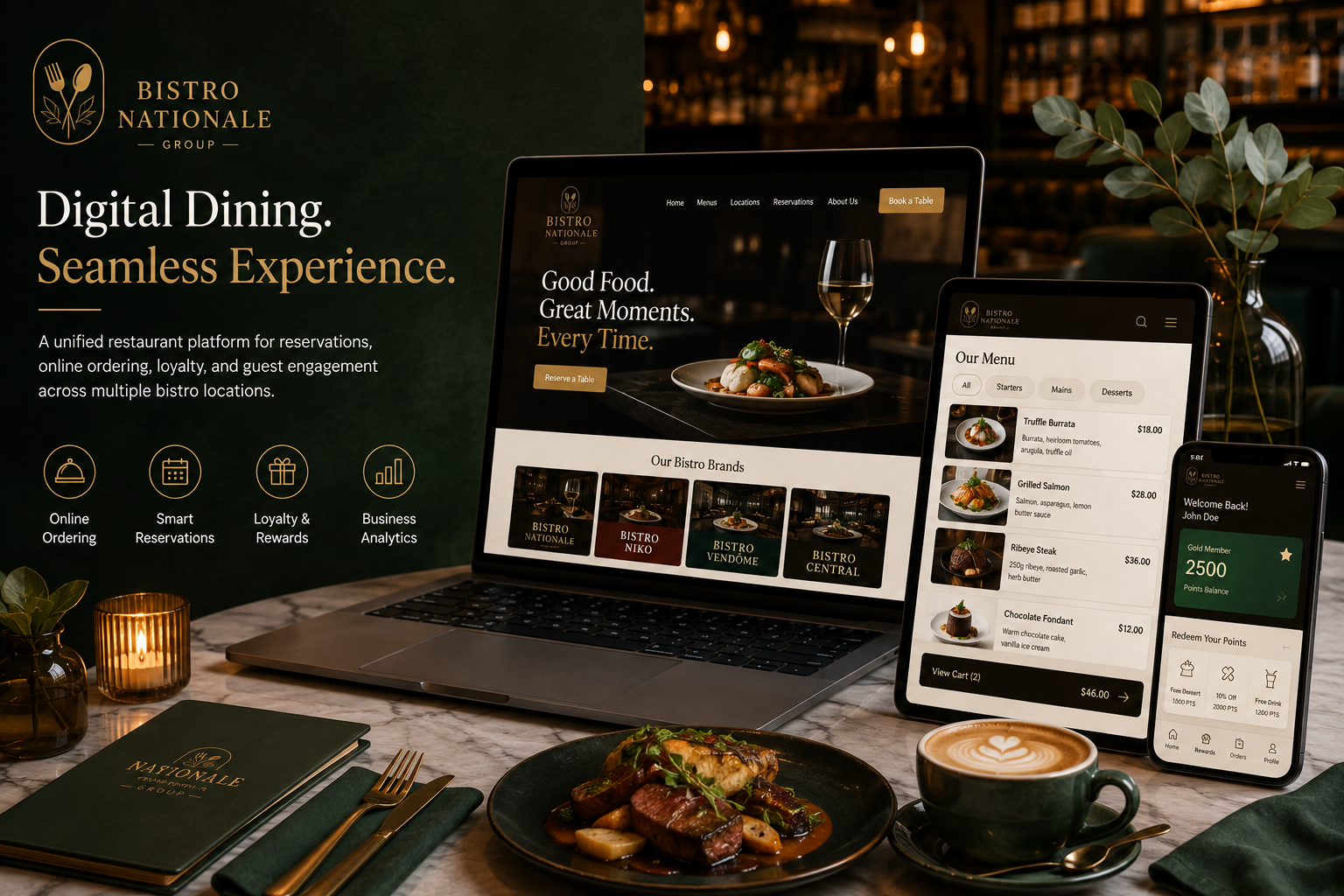
For online ordering, we built a first-party ordering website and app so Bistro Nationale could capture direct orders without paying aggregator commission on every single one — while deliberately keeping a presence on the aggregators too, since they still bring in customers who wouldn't have found Bistro Nationale otherwise. The goal was shifting the mix, not eliminating a channel that still has real value.
Paper kitchen tickets were replaced with a digital kitchen display system running on tablets, which cut ticket-to-completion time noticeably during peak service and gave kitchen staff a much clearer view of order queue and timing. Centralized menu management meant a price change or new seasonal item could roll out chain-wide in minutes instead of days, with head office controlling exactly which locations received which menu at what time.
We piloted the kitchen display system and unified POS layer at a handful of locations before the full rollout, going location by location afterward — each restaurant has its own service rhythm and staff comfort with new technology, so a single "flip the switch everywhere" rollout would have created more disruption than the phased approach we used.
Modules delivered
| Module | Purpose |
|---|---|
Unified POS Data Layer |
Normalizes sales and inventory data across different underlying POS systems. |
First-Party Online Ordering |
A branded ordering website and app that captures orders without aggregator commission. |
Digital Kitchen Display System (KDS) |
Tablet-based order tickets replacing paper, with clear queue and timing visibility. |
Chain-Wide Sales & Inventory Dashboard |
Real-time visibility into every location for head office. |
Centralized Menu Management |
Push menu and pricing updates chain-wide, or to specific locations, in minutes. |
Loyalty & Promotions Engine |
Chain-wide loyalty rewards and location-specific promotions. |
Key Features
Unified POS Layer
Consistent sales and inventory data across every location.
First-Party Online Ordering
Branded ordering without aggregator commission.
Digital Kitchen Display
Faster, clearer order tickets replacing paper.
Chain-Wide Dashboard
Real-time sales and inventory visibility for head office.
Centralized Menu Management
Push menu and price changes chain-wide in minutes.
Loyalty & Promotions
Chain-wide rewards and location-specific promotions.
Technology Stack
Delivery Process
-
1
Multi-POS Landscape Audit
Cataloged every POS system in use across the 85 locations and their data export capabilities.
-
2
Unified Data Layer Design
Built a normalization layer sitting above existing POS hardware wherever possible.
-
3
First-Party Ordering Platform Build
Developed the branded ordering website and app to reduce aggregator dependency.
-
4
Kitchen Display System Pilot
Tested the digital KDS at a handful of locations before wider rollout.
-
5
Location-by-Location Rollout
Rolled out the full platform gradually, respecting each location's own service rhythm.
-
6
Head Office Dashboard Launch
Launched the chain-wide sales and inventory dashboard once enough locations were connected.
Security & Compliance
| Measure | How it was handled |
|---|---|
PCI-DSS Compliant Payments |
All online and in-app payments are processed through a PCI-DSS compliant gateway. |
French Food Service Regulations |
Ordering and allergen-disclosure workflows align with French food service regulatory requirements. |
GDPR-Compliant Ordering Data |
Customer ordering and loyalty data handling complies with EU GDPR. |
Results & Impact
Results reported for this project after launch.
Before vs. after
| Before | After |
|---|---|
| Fragmented POS systems per location | Unified data layer across all 85 locations |
| Heavy dependence on aggregator fees | First-party ordering capturing significant share |
| Paper kitchen tickets | Digital kitchen display system |
| Days to roll out menu changes | Minutes, chain-wide |
Client Feedback
We'd grown to 85 locations through acquisitions, which sounds great until you realize you've also acquired 85 different ways of running a POS system. Kawach found a way to unify our data without forcing every location to rip out their hardware, and cutting our aggregator fee spend by a third funded a big chunk of the project on its own.
Key Achievements
-
Unified Data Across 85 Locations
Previously disconnected POS systems now feed one consistent chain-wide data layer.
-
Aggregator Fee Spend Down a Third
First-party ordering adoption cut overall aggregator commission spend by 34%.
-
Menu Updates: Days to Minutes
Chain-wide menu and pricing changes that used to take days now roll out in minutes.
Frequently Asked Questions
Did all 85 locations need new POS hardware?
No — the unified data layer was built to sit above existing POS hardware wherever possible, avoiding a costly hardware replacement across all 85 locations.
Did Bistro Nationale drop the third-party delivery aggregators entirely?
No. The goal was shifting order mix toward first-party ordering to reduce commission costs, not eliminating aggregators, which still bring in customers who wouldn't otherwise discover the brand.
How did kitchen staff adapt to the digital ticket system?
We piloted the kitchen display system at a handful of locations first and adjusted the interface based on real kitchen staff feedback before rolling it out further.
How is customer ordering data handled under GDPR?
Customer ordering and loyalty program data is handled in compliance with EU GDPR, with clear consent capture built into the first-party ordering flow.