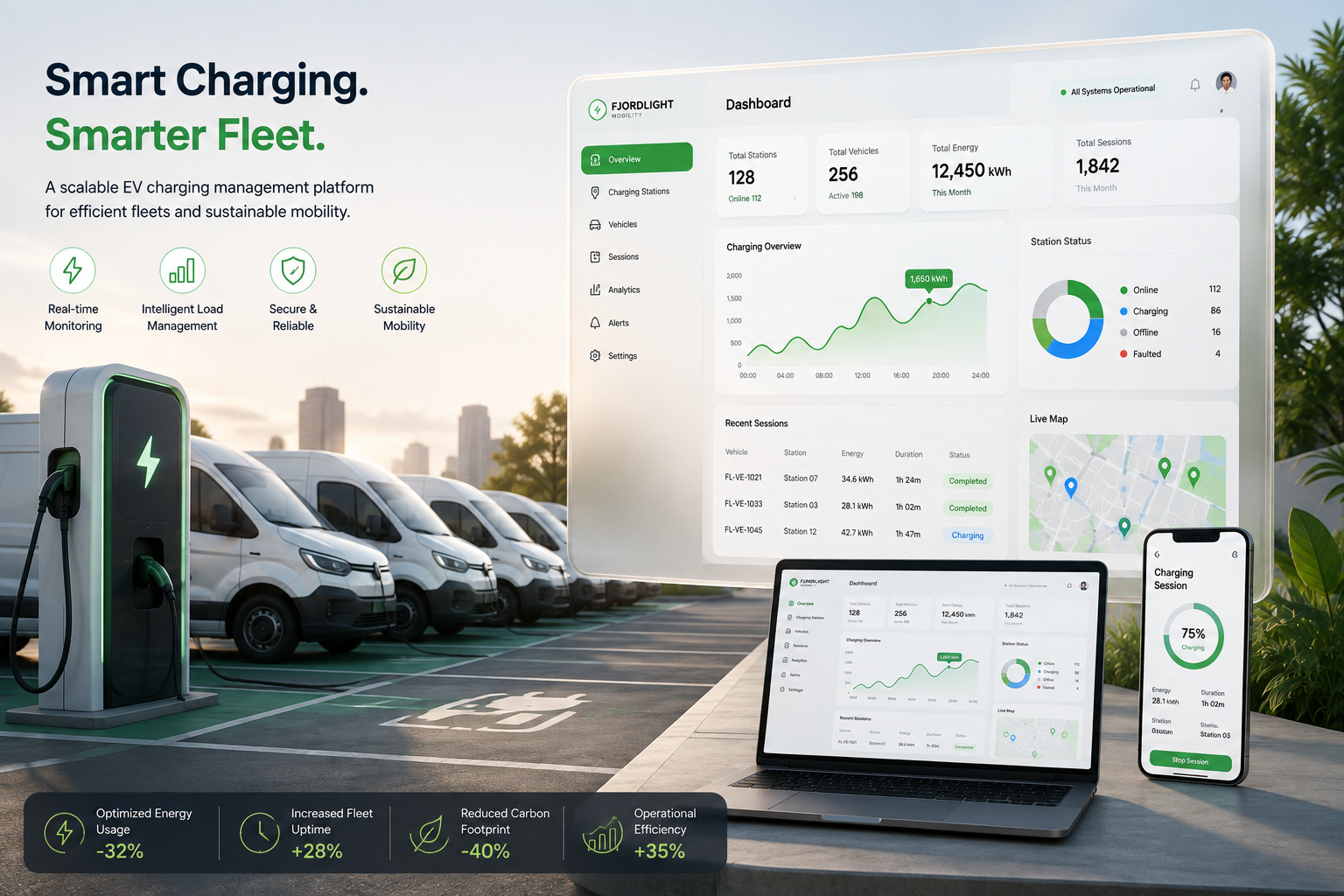
Managing 3,200+ EVs and a Growing Charging Network for Fjordlight Mobility Managing 3,200+ EVs and a Growing Charging Network for Fjordlight Mobility
1 0 1 1 0 0 1 0
0 1 0 0 1 1 0 1
1 1 0 1 0 1 1 0
0 0 1 0 1 0 0 1
Back to Case Studies
Case Study: Electric Vehicle Fleet & Charging Networks

Managing 3,200+ EVs and a Growing Charging Network for Fjordlight Mobility

How Kawach Technology built a real-time fleet telematics and smart charging platform for Fjordlight Mobility, managing 3,200+ EVs across the Nordics.

Electric Vehicle Fleet & Charging Networks 9 months Jun 2026
Explore Project
-19%
Charging Cost per Vehicle
Hours → Minutes
Station Downtime Detection
+23%
Fleet Utilization
Days → Automated
Sustainability Report Generation

Client Overview

Fjordlight Mobility AB

Fjordlight Mobility grew its Nordic electric vehicle fleet from a few hundred vehicles to more than 3,200 in a few years — a genuine growth success story that had completely outpaced the spreadsheet-based fleet tracking the company started with. What worked for a few hundred vehicles simply couldn't scale to thousands, and the cracks were showing everywhere. Charging station faults or downtime we...

Industry
Electric Vehicle Fleet & Charging Networks
Business Size
Nordic EV fleet operator, 3,200+ vehicles
Location
Gothenburg, Sweden · Software development in Europe
Business Model
EV Fleet & Charging Network Operator
Project Duration
9 months
Existing Challenges
  • Fleet tracking was still managed in spreadsheets, which hadn't scaled past a few hundred vehicles let alone 3,200+.
  • Charging station faults or downtime were often only discovered when a driver arrived and couldn't charge.
  • Vehicles charged whenever plugged in with no coordination, driving up costs during peak electricity demand periods.
  • Corporate fleet clients increasingly asked for emissions and sustainability reports Fjordlight had no automated way to produce.
  • Route and vehicle assignment planning didn't account for real-time battery range or charging station availability.
The Challenge

What We Were Up Against

Fjordlight Mobility grew its Nordic electric vehicle fleet from a few hundred vehicles to more than 3,200 in a few years — a genuine growth success story that had completely outpaced the spreadsheet-based fleet tracking the company started with. What worked for a few hundred vehicles simply couldn't scale to thousands, and the cracks were showing everywhere.

Charging station faults or downtime were often only discovered the hard way: a driver would arrive at a station expecting to charge and find it wasn't working, with no advance warning to reroute them elsewhere. Vehicles charged whenever they happened to be plugged in, with no coordination across the fleet, which meant charging costs spiked during peak electricity demand periods that smarter scheduling could easily have avoided.

Corporate fleet clients — a growing and increasingly important part of Fjordlight's business — were asking for emissions and sustainability reports as standard due diligence, and Fjordlight had no automated way to produce them; compiling one meant manual data-pulling that didn't scale as the client roster grew. Route and vehicle assignment planning didn't account for real-time battery range or charging station availability either, occasionally assigning a route a vehicle couldn't comfortably complete without an unplanned charging stop.

Our Solution

How We Built It

The foundational piece was real-time fleet telematics — pulling live location, battery state, and vehicle health data from all 3,200+ vehicles into one platform, replacing spreadsheets that had never been designed for this scale in the first place. That same telemetry approach extended to the charging network itself, so station faults surface as an alert within minutes rather than being discovered by a stranded driver.

Smart charge scheduling was the piece with the clearest direct cost impact: rather than every vehicle charging the moment it's plugged in, the system coordinates charging across the fleet to shift load toward off-peak electricity pricing windows wherever a vehicle's schedule allows the flexibility, meaningfully reducing per-vehicle charging costs without requiring drivers to think about electricity pricing at all.

For corporate clients, we built an automated sustainability and emissions reporting module that pulls directly from real fleet telematics data — actual distance driven, actual charging sourced, not estimates — turning what used to be a manual, multi-day report-building exercise into something Fjordlight's account managers can generate on demand for any client, for any time period.

Range-aware route and vehicle assignment closed the loop: the system now factors in each vehicle's actual current battery range and nearby charging station availability before assigning it to a route, preventing the awkward situation of a vehicle being assigned a route it can't comfortably complete. We piloted the full platform on a 400-vehicle sub-fleet, deliberately including a mix of vehicle models and route types, before extending it across the full fleet and charging network.

Key Modules Delivered
Real-Time Fleet Telematics
Live location, battery state, and vehicle health data for 3,200+ vehicles.
Charging Station Health Monitoring
Proactive fault alerts before a driver arrives at a non-functional station.
Smart Charge Scheduling
Coordinates fleet charging to shift load toward off-peak electricity pricing.
Sustainability & Emissions Reporting
Automated, data-backed reports generated directly from real telematics data.
Range-Aware Route Assignment
Assigns vehicles to routes accounting for real battery range and charging availability.
Corporate Client Reporting Portal
On-demand sustainability and usage reports for corporate fleet clients.
Goals & Objectives

What Success Looked Like

Scale Fleet Visibility Beyond Spreadsheets

Track 3,200+ vehicles in real time instead of manual spreadsheets.

Monitor Charging Network Health

Detect charging station faults within minutes, not after a driver is stranded.

Optimize Charging Costs

Shift charging load to off-peak periods wherever possible.

Automate Sustainability Reporting

Generate real, data-backed emissions reports for corporate clients on demand.

Features Developed

What We Built

Real-Time Fleet Telematics

Live tracking of location, battery, and vehicle health.

Charging Station Health Monitoring

Proactive fault detection before drivers are affected.

Smart Charge Scheduling

Shifts fleet charging toward off-peak pricing windows.

Automated Sustainability Reporting

Data-backed emissions reports generated on demand.

Range-Aware Route Assignment

Vehicle assignment that accounts for real battery range.

Corporate Client Portal

On-demand usage and sustainability reports for clients.

Technology Stack

Built With the Right Tools

We selected every technology based on this project's real requirements: compliance obligations, scalability needs, and long-term maintainability. No trend-chasing, only battle-tested solutions.

Backend
Django TimescaleDB (telematics data)
Data Ingestion
MQTT from vehicles and charging stations
Frontend
React
Infrastructure
Azure EU data residency
Development Process

How We Delivered It

Agile delivery with regular demos and continuous deployment. Full transparency at every stage.

Total Timeline
9 months
Started → Ongoing
1
01
Fleet & Charging Network Audit

Assessed existing telemetry availability across vehicles and charging stations.

2
02
Telematics Data Pipeline Build

Built the MQTT-based ingestion pipeline feeding a central time-series platform.

3
03
Smart Charge Scheduling Algorithm Design

Designed scheduling logic to shift charging load off-peak wherever vehicle schedules allow.

4
04
Sustainability Reporting Framework

Built automated emissions and usage reporting directly from telematics data.

5
05
Pilot on 400-Vehicle Sub-Fleet

Validated the platform on a representative mix of vehicle models and route types.

6
06
Full Fleet & Network Rollout

Extended the platform across all 3,200+ vehicles and the full charging network.

Security & Compliance

Built for the Strictest Standards

EU Data Residency
Fleet and driver data is stored and processed within EU-based infrastructure.
GDPR-Compliant Driver Data
Driver and vehicle usage data handling complies with GDPR requirements.
Sustainability Reporting Standards
Emissions reports align with recognized corporate sustainability reporting standards.
Results / KPIs

Measurable Impact

Numbers measured at 6 months post-launch, independently verified by the client's operations team.

-19%
Charging Cost per Vehicle
Hours → Minutes
Station Downtime Detection
+23%
Fleet Utilization
Days → Automated
Sustainability Report Generation

Before vs. After

Before After
Spreadsheet fleet trackingReal-time telematics for 3,200+ vehicles
Charging faults discovered by stranded driversProactive station health monitoring
Uncoordinated peak-hour chargingSmart scheduling shifting load off-peak
Manual sustainability reportsAutomated corporate reporting portal
"
We grew our fleet faster than our own tools could keep up with, and it showed — drivers stranded at broken chargers, charging costs creeping up for no clear reason, corporate clients asking for sustainability numbers we couldn't easily produce. Real-time visibility across 3,200 vehicles fixed all of that at once, and the automated sustainability reports have actually become something our sales team leads with now instead of scrambling to produce after the fact.
ER
Erik Lindqvist
Head of Fleet Operations, Fjordlight Mobility AB
★★★★★
Key Achievements

Why This Project Matters

Beyond the numbers: what this project changed day-to-day for Fjordlight Mobility AB and the people who rely on what we built.

Real-Time Visibility for 3,200+ Vehicles
Fleet tracking scaled from spreadsheets to real-time telematics across the entire fleet.
Charging Costs Cut Per Vehicle
Smart charge scheduling reduced per-vehicle charging costs by 19%.
Sustainability Reporting Fully Automated
Corporate clients now receive data-backed emissions reports on demand instead of waiting days.
FAQ

Common Questions

Have more questions? Book a call with our team.

How did you scale telematics tracking to thousands of vehicles?
We built the ingestion pipeline on a time-series database specifically designed for high-volume telemetry data, and validated it on a 400-vehicle pilot fleet before extending to the full 3,200+ vehicle fleet.
Does smart charging scheduling reduce driver flexibility?
Only within limits the driver's own schedule allows — the system shifts charging to off-peak windows when a vehicle has flexibility, but never delays charging a vehicle that needs to be ready sooner.
How accurate is the sustainability reporting?
Reports are generated directly from real telematics data — actual distance driven and actual energy consumed — rather than estimates, which is specifically what corporate clients wanted when they started requesting these reports.
How is driver and vehicle data protected under GDPR?
All fleet and driver data is stored on EU-based infrastructure with access controls and data handling practices designed to meet GDPR requirements from the start.
Related Case Studies

More Success Stories

Ready to Get Started?

Looking for Custom Electric Vehicle Fleet & Charging Networks Software Development?

Kawach Technology helps startups and enterprises build scalable, secure, and high-performance digital platforms. Let's turn your vision into the next success story.

View All Case Studies

Want a similar result for your business? Explore our Custom Software Development services , or see how we work with businesses in Europe , or get in touch directly.