Executive Summary
How Kawach Technology built a direct booking platform for Harborview Hospitality Group, growing direct bookings 31% and cutting OTA commission costs 24%.
- +31% direct booking share
- -24% ota commission costs
- +17% repeat guest rate
- +2.3x booking conversion rate
Project fact sheet
| Client | Harborview Hospitality Group |
| Industry | Hospitality / Boutique Hotels |
| Location | London, United Kingdom · Software development in the UK |
| Business size | 22 boutique hotels across the UK and Ireland |
| Business model | Boutique Hotel Group |
| Project duration | 7 months |
| Core technology | Laravel, React, PostgreSQL, Channel Manager API, Stripe, AWS |
The Challenge
Harborview Hospitality Group runs 22 boutique hotels across the UK and Ireland, each with its own character but sharing one uncomfortable business reality: roughly 70% of reservations arrived through third-party online travel agencies charging 15-20% commission on every booking. That's a substantial and growing tax on revenue for a hotel group whose guests, once they'd stayed once, often genuinely preferred booking directly — they just weren't given a good enough reason or interface to do so.
Each property still ran its own booking widget, and most of them were badly outdated relics from a decade of incremental patches rather than any real redesign. Guest profiles didn't carry over between properties either, so a guest who'd stayed at the Bath property twice and was now booking the London property for the first time was treated, digitally, as a total stranger — no recognition, no personalization, nothing that might have nudged them toward loyalty.
Behind the scenes, rate parity across OTAs and the direct site was checked and adjusted by hand, which meant occasional embarrassing mismatches where the OTA listing undercut Harborview's own direct rate. And there was no loyalty or rewards program of any kind — nothing systematically encouraging the guests most likely to book direct to actually do so.
Key problems identified
| # | Problem |
|---|---|
| 01 | Roughly 70% of bookings came through OTAs charging 15-20% commission per reservation. |
| 02 | Each property had its own outdated booking widget, discouraging direct bookings. |
| 03 | Guest profiles didn't carry over between properties, so repeat guests were treated as first-timers. |
| 04 | Rate parity across OTAs and the direct site was checked and adjusted manually, risking rate mismatches. |
| 05 | There was no loyalty or personalization program to encourage guests to book direct. |
Goals & Objectives
| Objective | What success meant |
|---|---|
Increase Direct Bookings |
Reduce dependency on high-commission OTA bookings. |
Unify Guest Profiles Group-Wide |
Recognize repeat guests across all 22 properties, not just one. |
Automate Rate Parity |
Keep direct and OTA rates consistent without manual checking. |
Launch a Loyalty Program |
Give guests a real incentive to book direct and stay loyal to the group. |
The Solution
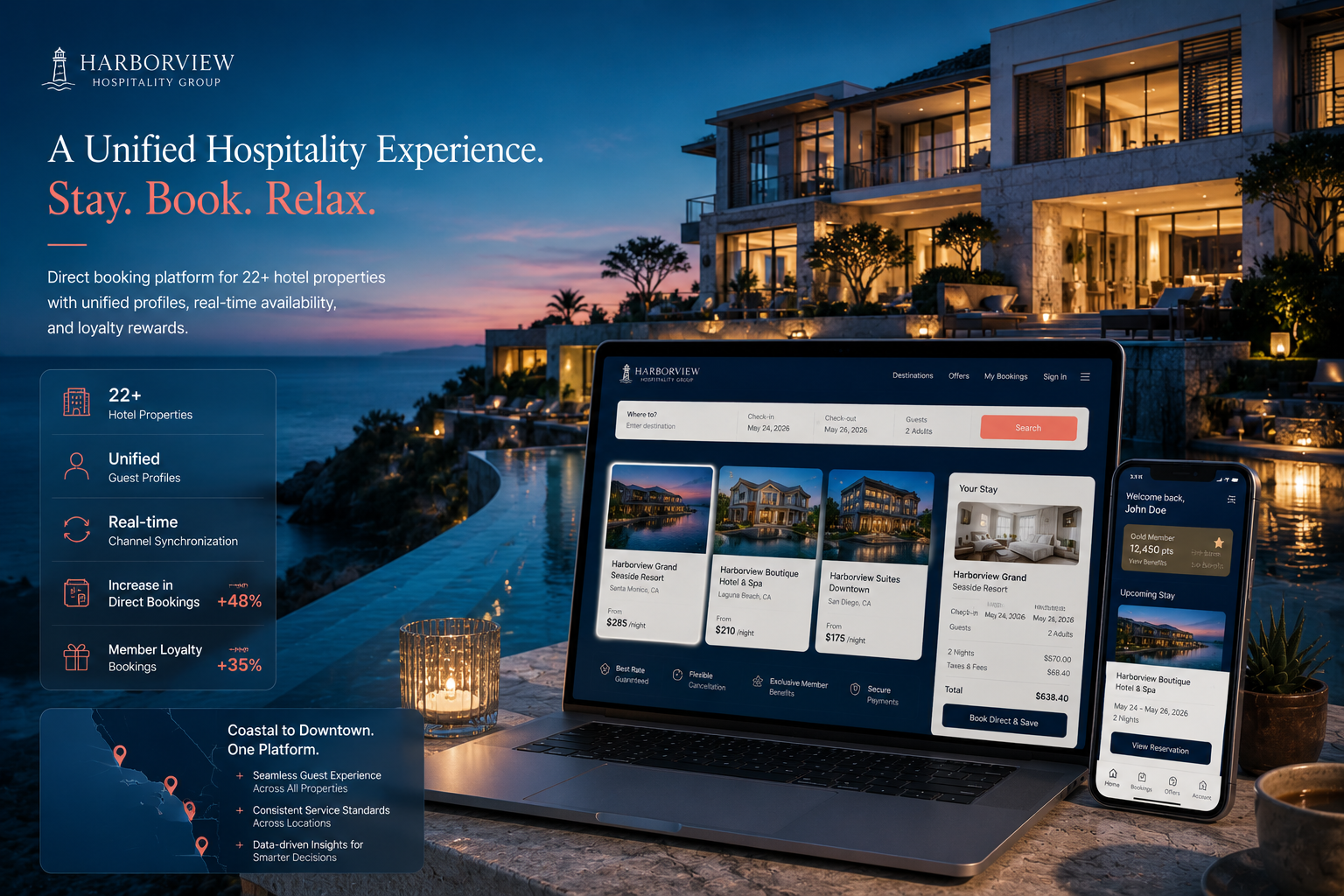
We built a single, modern direct-booking engine to replace the patchwork of outdated per-property widgets, integrated with a channel manager so availability and rates sync automatically across every OTA Harborview lists on, plus the direct site. That sync is what made automated rate parity possible — the platform now compares direct and OTA rates continuously and flags mismatches before a guest ever sees one.
The bigger structural change was a unified guest profile that follows a traveler across all 22 properties. A guest who's stayed at the Bath property now gets recognized the moment they start booking the London property — same loyalty tier, same preferences on file, same booking history — which is the foundation the new loyalty and rewards program builds on.
We piloted the new booking engine and guest CRM on four flagship properties first, chosen specifically to represent Harborview's range from city-center business hotels to countryside retreats, since guest behavior differs meaningfully between them. That pilot shaped several UX decisions — countryside-property guests, for instance, booked further in advance and cared more about photos of the grounds than city-property guests did, which changed how we prioritized content on each property's booking page.
Group-wide rollout followed once the pilot metrics looked solid, alongside the loyalty program launch — timed together deliberately, since a loyalty program with no meaningfully improved booking experience behind it tends to underwhelm.
Modules delivered
| Module | Purpose |
|---|---|
Direct Booking Engine |
A single modern booking flow replacing 22 separate outdated property widgets. |
Channel Manager Integration |
Automatic availability and rate sync across every listed OTA plus the direct site. |
Unified Guest Profile (CRM) |
One guest history and preference record that follows travelers across all 22 properties. |
Dynamic Rate Parity Automation |
Continuous comparison of direct vs. OTA rates with automatic mismatch alerts. |
Loyalty & Rewards Program |
Tiered rewards for direct bookings and repeat stays across the group. |
PMS Sync |
Real-time sync with each property's existing property management system. |
Key Features
Direct Booking Engine
A modern booking flow replacing outdated per-property widgets.
Unified Guest Profiles
Guest history and preferences follow travelers across all properties.
Automated Rate Parity
Continuous monitoring keeps direct and OTA rates aligned.
Loyalty Program
Tiered rewards encouraging direct bookings and repeat stays.
Channel Manager Sync
Automatic availability and rate sync across every OTA.
Mobile-Optimized Booking
A fast, modern booking flow on any device.
Technology Stack
Delivery Process
-
1
Property & OTA Dependency Audit
Assessed booking mix and commission spend across all 22 properties to prioritize where direct booking gains mattered most.
-
2
Booking Engine Design
Designed a single modern booking flow to replace 22 separate outdated widgets.
-
3
Channel Manager Integration
Connected the new engine to the channel manager for automatic rate and availability sync.
-
4
Guest CRM Migration
Consolidated guest history from all properties into one unified profile system.
-
5
Pilot on 4 Flagship Properties
Tested the new booking engine and CRM on a representative mix of city and countryside properties.
-
6
Group-Wide Rollout
Launched across all 22 properties alongside the new loyalty program.
Security & Compliance
| Measure | How it was handled |
|---|---|
PCI-DSS Compliant Payments |
All booking payments are processed through a PCI-DSS compliant gateway. |
GDPR-Compliant Guest Data |
Guest profile and booking data handling complies with UK GDPR across both UK and Irish properties. |
Secure Guest Profile Storage |
Unified guest data is encrypted and access-controlled by role. |
Results & Impact
Results reported for this project after launch.
Before vs. after
| Before | After |
|---|---|
| ~70% OTA-dependent bookings | Majority of bookings now direct |
| Guest profiles isolated per property | Unified guest history across all 22 properties |
| Manual rate parity checks | Automated parity monitoring across channels |
| No loyalty program | Active tiered rewards program driving repeat stays |
Client Feedback
Watching nearly three-quarters of our bookings flow through OTA commissions for years, you start to feel like you're renting your own guests back. The direct booking platform and loyalty program together completely changed that math — and honestly, the unified guest profiles have done more for how personal our service feels than any single property-level initiative we've tried.
Key Achievements
-
Direct Bookings Grew from ~30% to Over 60%
The share of bookings coming directly rather than through OTAs more than doubled within a year.
-
Material Reduction in OTA Commission Spend
Overall OTA commission costs dropped 24% as direct booking share grew.
-
Thousands of Loyalty Signups in the First Quarter
The new loyalty program attracted strong guest signup numbers immediately after launch.
Frequently Asked Questions
Did Harborview stop listing on OTAs entirely?
No — OTAs still bring valuable discovery traffic, especially for new guests. The goal was shifting the mix toward direct bookings for guests likely to book direct anyway, not eliminating OTA presence.
How is guest data handled across UK and Irish properties under GDPR?
The unified guest profile system was built with UK GDPR compliance as a first-class requirement from the start, including clear consent capture and data handling consistent across both jurisdictions.
How did the platform integrate with each property's existing PMS?
We built a PMS sync layer that connects to each property's existing property management system individually, since the 22 hotels didn't all run the same PMS — a unifying layer was more practical than forcing a single PMS switch.
How quickly did guests adopt the new loyalty program?
Signups reached the thousands within the first quarter after launch, helped by timing the loyalty launch alongside the new, meaningfully better booking experience rather than as a standalone announcement.