Executive Summary
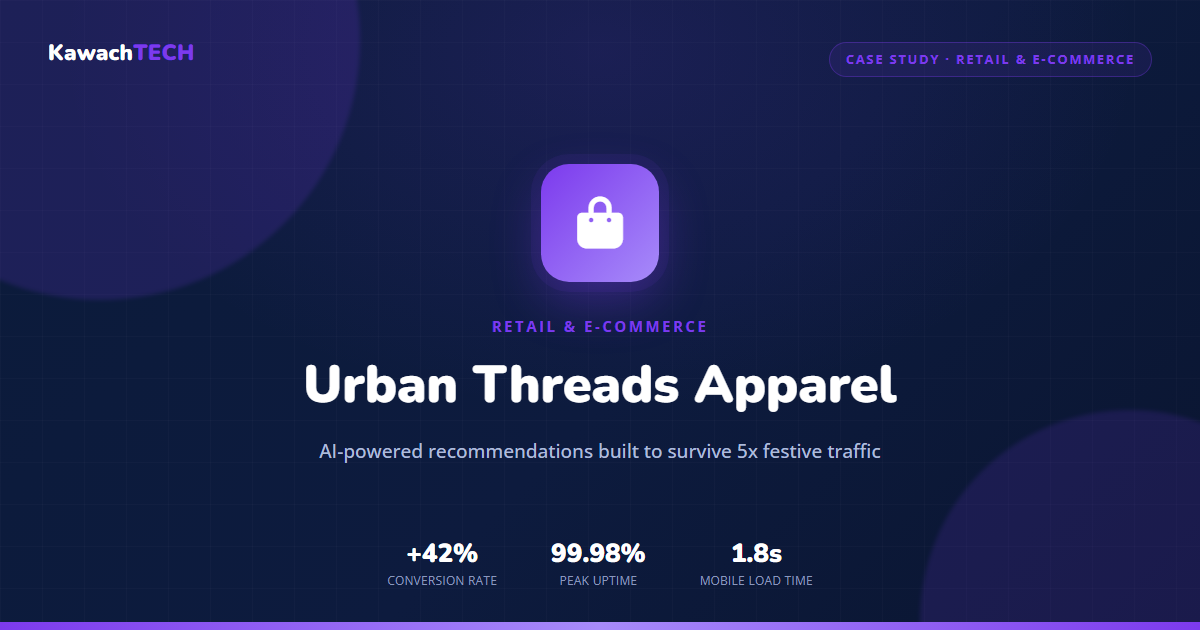
How Kawach Technology rebuilt Urban Threads' online store to survive 5x festive traffic and lift conversion 42% with AI-powered product recommendations.
- 1.8s (from 6s+) mobile page load time
- 99.98% festive season uptime
- -31% cart abandonment
- +42% conversion rate
Project fact sheet
| Client | Urban Threads Apparel |
| Industry | Retail & E-commerce · Retail Software Development |
| Location | Delhi NCR, India |
| Business size | ₹15 Cr+ annual online revenue |
| Business model | Direct-to-Consumer (D2C) Fashion Retail |
| Project duration | 5 months |
| Core technology | Laravel, React, Redis, Elasticsearch, AWS, Python (ML) |
The Challenge
Urban Threads Apparel had built a genuinely loyal D2C fashion customer base, but their online store had a problem that only showed up at the worst possible moment: every major flash sale or festive campaign — precisely the events driving the most revenue of the year — the site slowed to a crawl or crashed outright. Customers gave up and left, and the team could only watch it happen in real time.
Beyond the crashes, the storefront treated every visitor identically. A first-time browser and a five-time repeat customer saw the exact same homepage and product listings, with no attempt to surface what either of them was actually likely to buy. Inventory counts were only updated manually every few hours, which meant overselling during high-traffic sales — a customer service nightmare that meant refunding orders the warehouse simply couldn't fulfill.
Cart abandonment sat above 78%, with no automated way to bring those customers back. And because 85% of Urban Threads' traffic came from mobile, the storefront's average mobile page load time of over 6 seconds was quietly costing sales on every single visit, not just during sale events.
Key problems identified
| # | Problem |
|---|---|
| 01 | The storefront repeatedly slowed down or crashed during flash sales and festive campaigns — the exact moments driving the most revenue. |
| 02 | Every customer saw the same generic homepage and product listings, regardless of browsing or purchase history. |
| 03 | Inventory counts were updated manually every few hours, leading to overselling during high-traffic sales events. |
| 04 | Cart abandonment sat above 78%, with no automated way to re-engage customers who left without checking out. |
| 05 | Average mobile page load time — where 85% of traffic came from — was over 6 seconds. |
Goals & Objectives
| Objective | What success meant |
|---|---|
Survive Peak Traffic |
Rebuild the platform to reliably handle 5x normal traffic during festive sales without downtime. |
Personalize the Shopping Experience |
Show each customer product recommendations based on their own browsing and purchase behavior. |
Fix Inventory Accuracy |
Sync inventory across the storefront in real time to eliminate overselling. |
Recover Abandoned Carts |
Automatically re-engage customers who leave without completing checkout. |
The Solution
We opened with a performance audit, running load tests against the existing storefront to pin down exactly which parts of the stack buckled under pressure — it turned out to be a mix of an undersized database connection pool and no caching layer at all in front of product pages. That diagnosis shaped everything that followed: we re-architected the platform around auto-scaling cloud infrastructure and a Redis caching layer built specifically to absorb sudden traffic spikes.
For personalization, we trained a recommendation model on two years of Urban Threads' own historical browsing and purchase data — deliberately avoiding third-party data brokers — before deploying it live. Real-time inventory sync and automated abandoned-cart email/SMS sequences shipped first, since they delivered value immediately; AI-driven recommendations followed once the core platform had proven stable.
Before trusting any of it with a live festive campaign, we simulated 5x Urban Threads' expected peak traffic in a staging environment and tuned auto-scaling rules until the platform absorbed that simulated load without a single error. Image optimization and CDN delivery were layered in specifically to address the mobile load-time problem, since that's where the overwhelming majority of visitors actually were.
We stayed on real-time monitoring and on-call support throughout Urban Threads' biggest sales campaign of the year — the actual moment of truth the whole rebuild had been aimed at.
Modules delivered
| Module | Purpose |
|---|---|
AI Recommendation Engine |
A machine-learning model that ranks product recommendations per visitor using browsing history, purchase patterns, and real-time trending items. |
Real-Time Inventory Sync |
Inventory updates propagate to the storefront within seconds of a sale, across all sales channels. |
Abandoned Cart Automation |
Automated email and SMS sequences triggered when a cart is left inactive, with time-limited discount nudges. |
Auto-Scaling Storefront |
Cloud infrastructure that automatically scales server capacity up during traffic spikes and back down afterward. |
Image & CDN Optimization |
Automatic image compression and global CDN delivery to cut mobile page load times. |
Key Features
AI Product Recommendations
Personalized product suggestions based on real browsing and purchase behavior.
Auto-Scaling Infrastructure
Automatically handles traffic spikes during flash sales without downtime.
Real-Time Inventory Sync
Prevents overselling by updating stock instantly across channels.
Abandoned Cart Recovery
Automated email/SMS sequences that bring shoppers back to checkout.
Optimized Mobile Performance
Sub-2-second load times even on average mobile connections.
Technology Stack
| Layer | Technologies |
|---|---|
| Backend | |
| Frontend | |
| Search & Recommendations | |
| Infrastructure |
Delivery Process
-
1
Performance Audit
Ran load tests against the existing storefront to identify the exact bottlenecks that caused crashes during past sales events.
-
2
Architecture Redesign
Re-architected the platform around auto-scaling infrastructure and a caching layer to absorb sudden traffic spikes.
-
3
Recommendation Model Training
Trained the recommendation model on 2 years of historical browsing and purchase data before deploying it live.
-
4
Phased Feature Rollout
Shipped inventory sync and cart automation first, then layered in AI recommendations once the core platform was stable.
-
5
Load Testing at Scale
Simulated 5x expected festive traffic in a staging environment before the live campaign to validate auto-scaling behavior.
-
6
Live Festive Season Monitoring
Provided real-time monitoring and on-call support throughout the client's biggest sales campaign of the year.
Security & Compliance
| Measure | How it was handled |
|---|---|
Payment Data Security |
Checkout is processed through PCI-DSS compliant payment gateways — no raw card data is stored on Urban Threads' servers. |
Customer Data Protection |
Personal and browsing data used for recommendations is encrypted and access-controlled per internal data policy. |
Results & Impact
Results reported for this project after launch.
Before vs. after
| Before | After |
|---|---|
| Storefront crashed during high-traffic sales events | 99.98% uptime during 5x festive traffic |
| Same generic homepage shown to every visitor | AI-personalized recommendations per visitor |
| Manual inventory updates every few hours | Real-time inventory sync across all channels |
| 78%+ cart abandonment with no follow-up | 31% reduction in cart abandonment via automation |
Client Feedback
Every festive season used to be a nail-biter — we knew a big sale meant a good chance the site would slow to a crawl right when we needed it most. This time, traffic was five times normal and the site didn't even blink. And the personalized recommendations alone paid for the project within the first quarter.
Key Achievements
-
Zero Downtime During Peak Sale
The platform handled 5x normal traffic during the festive campaign with 99.98% uptime and no checkout failures.
-
42% Conversion Rate Increase
AI-driven product recommendations lifted overall conversion rate by 42% within the first full quarter after launch.
-
Mobile Load Time Cut by Over 70%
Image optimization and CDN delivery brought mobile page load time down from over 6 seconds to under 2.
Frequently Asked Questions
How did you prepare the platform for festive-season traffic specifically?
We simulated 5x the client's expected peak traffic in a staging environment weeks before the actual sale, tuning auto-scaling rules until the platform handled the simulated load with zero errors.
How does the AI recommendation engine work without being invasive?
It only uses first-party behavioral data — pages viewed, items purchased, items added to cart — collected directly on Urban Threads' own store, with no third-party data brokers involved.
Did the redesign require Urban Threads to change their existing product catalog structure?
No. We built the new platform to migrate the existing product catalog as-is, so the merchandising team didn't need to re-enter or restructure any product data.