Releasing Software With Confidence Requires More Than Hope
Every software team wants to ship fast. The problem is that speed without structured quality assurance does not actually get you there faster — it just moves the discovery of problems from your test environment to your users' screens. A critical bug found in production costs orders of magnitude more to fix than one caught in a pull request review. A performance regression that slows page load by two seconds can measurably reduce conversion. A security vulnerability missed in testing can become a breach that costs far more than the entire development project.
At Kawach Technology, quality assurance is not a final checkbox before release — it is an engineering discipline embedded throughout the development lifecycle. Our QA practice works with engineering teams across North America, Europe, the Middle East, and Asia-Pacific to build testing strategies, automation infrastructure, and quality processes that genuinely reduce risk rather than just generating test reports.
Our Quality Engineering Services
Quality assurance spans a wide range of activities depending on the type of software, the stage of development, and the risk profile of the release. Kawach covers the full spectrum:
Functional Testing - Systematic verification that every feature works as specified - across user flows, edge cases, boundary conditions, and integration points - not just the happy path.
Test Automation - Design and implementation of automation frameworks and test suites that provide fast, reliable feedback on every code change, reducing the manual testing burden and enabling continuous delivery.
Performance & Load Testing - Capacity testing, stress testing, and load simulation to understand how the system behaves under realistic and peak traffic conditions - before users discover the breaking point.
Security Testing - Penetration testing, OWASP-aligned vulnerability assessments, authentication and authorisation testing, and API security validation to identify exploitable weaknesses before they are exploited.
API Testing - Comprehensive testing of REST, GraphQL, and gRPC APIs - covering contract validation, error handling, authentication, rate limiting, and integration behaviour across service boundaries.
Mobile Application Testing - Functional, compatibility, and performance testing across iOS and Android platforms and a representative matrix of device types, OS versions, and network conditions.
Regression Testing - Structured regression suites that verify existing functionality remains intact after every code change, refactor, or dependency update - reducing the risk of silent regressions.
Usability & Accessibility Testing - Evaluation of the user interface against usability heuristics and WCAG accessibility standards - ensuring the product works well for all users, including those with accessibility needs.
QA Strategy & Process Consulting - For engineering teams that need to build or improve their quality function from the ground up - test strategy design, tool selection, team structure, and process integration with CI/CD pipelines.
Quality Problems We're Called In to Solve
The specific symptoms vary, but the underlying quality engineering problems follow recognisable patterns:
Releases that regularly introduce regressions because the test suite only covers core happy-path flows
Manual testing cycles that take two weeks and create a bottleneck that forces the team to batch releases rather than ship continuously
Performance degradations discovered in production - often after a traffic spike reveals a bottleneck nobody tested for
Security vulnerabilities reported by customers or external researchers that should have been caught internally
An automation suite that produces flaky, unreliable results and has lost the confidence of the engineering team
No clear ownership of quality - QA treated as a final gate rather than a shared engineering responsibility
Mobile apps with compatibility issues on specific device and OS combinations that nobody tested
API contracts that break silently when upstream services change, causing integration failures downstream
Test coverage metrics that look healthy on paper but miss entire categories of real-world usage
These problems compound over time. The longer they persist, the more expensive they become to fix - both in engineering time and in the trust your users place in the product.
How We Approach Quality Engineering
We start with a quality assessment: an honest review of your current testing practices, tool stack, test coverage, automation maturity, and how quality work fits into the delivery pipeline. This gives us a baseline and surfaces the highest-value improvements quickly.
From there, we work in one of two modes depending on your needs. For teams that need embedded QA support - additional capacity, specialist skills, or help standing up a quality function from scratch - our engineers work directly alongside your team, integrated into your sprints, ceremonies, and delivery process. For teams that need a defined testing engagement - a performance test of a specific release, a security assessment before a major launch, or an automation framework build - we scope, deliver, and hand over.
In both models, we write everything down. Test strategies, test plans, automation framework documentation, and findings reports are first-class deliverables. Your team should understand and own the quality infrastructure we help build - not depend on us to operate it indefinitely.
Core Testing Capabilities
Requirements-Driven Test Design - Test cases derived systematically from requirements, user stories, and acceptance criteria - ensuring coverage is deliberate and traceable rather than ad hoc.
Behaviour-Driven Development (BDD) Support - Test specifications written in business-readable language (Gherkin/Cucumber) that serve as both living documentation and executable acceptance criteria.
Continuous Testing Integration - Test automation integrated into CI/CD pipelines so that every code commit triggers the relevant test suites - providing fast feedback without manual intervention.
Cross-Browser & Cross-Platform Testing - Systematic compatibility verification across browsers, operating systems, screen resolutions, and device types to ensure consistent behaviour for all users.
Data-Driven Testing - Test suites parameterised to run across large and varied datasets, validating behaviour across the full range of inputs rather than a narrow set of hand-picked examples.
Exploratory Testing - Structured exploratory sessions by experienced QA engineers who apply domain knowledge and adversarial thinking to find issues that scripted tests miss.
Test Environment Management - Design and maintenance of stable, production-representative test environments that produce reliable results and do not generate false positives from environment inconsistency.
Defect Management & Triage - Structured defect reporting with clear reproduction steps, severity classification, and root cause analysis - giving development teams what they need to fix issues efficiently.
Test Automation That Actually Gets Used
Test automation is one of the most consistently misunderstood investments in software engineering. Done well, it dramatically reduces manual testing overhead and enables continuous delivery. Done poorly, it creates a maintenance burden that the team eventually abandons - leaving them worse off than before.
Kawach builds automation frameworks with maintainability as a first-order concern. We follow the test pyramid model - a solid foundation of fast unit tests, a well-designed layer of service/API tests, and a focused set of end-to-end tests for critical user journeys. We use page object models and component abstraction patterns that make automation suites resilient to UI changes. And we integrate automation into the CI/CD pipeline from day one rather than treating it as a separate activity.
Framework and tool selection is made based on your technology stack and team capability - not based on what we prefer. The automation suite we deliver is one your team can maintain, extend, and trust.
Performance Engineering - Before Users Find the Breaking Point
Performance testing is most valuable when it happens before a release, not after an incident. Kawach designs performance testing programmes that answer the specific questions that matter for your system:
What is the maximum concurrent user load the system can sustain before response times degrade?
Which components or database queries become bottlenecks as load increases?
How does the system behave under sustained load over hours rather than minutes?
What happens when load exceeds capacity - does the system degrade gracefully or fail catastrophically?
How quickly does the system recover after a spike subsides?
What are the infrastructure scaling thresholds that trigger auto-scaling, and do they trigger in time?
We use these findings to produce actionable optimisation recommendations - not just pass/fail metrics - so your engineering team knows exactly what to address before the next release.
Security Testing & Vulnerability Assessment
Security testing is not a commodity service where the same checklist applies to every application. The risk profile of a consumer mobile app is different from a B2B SaaS platform handling financial transactions, which is different again from a healthcare application processing patient data.
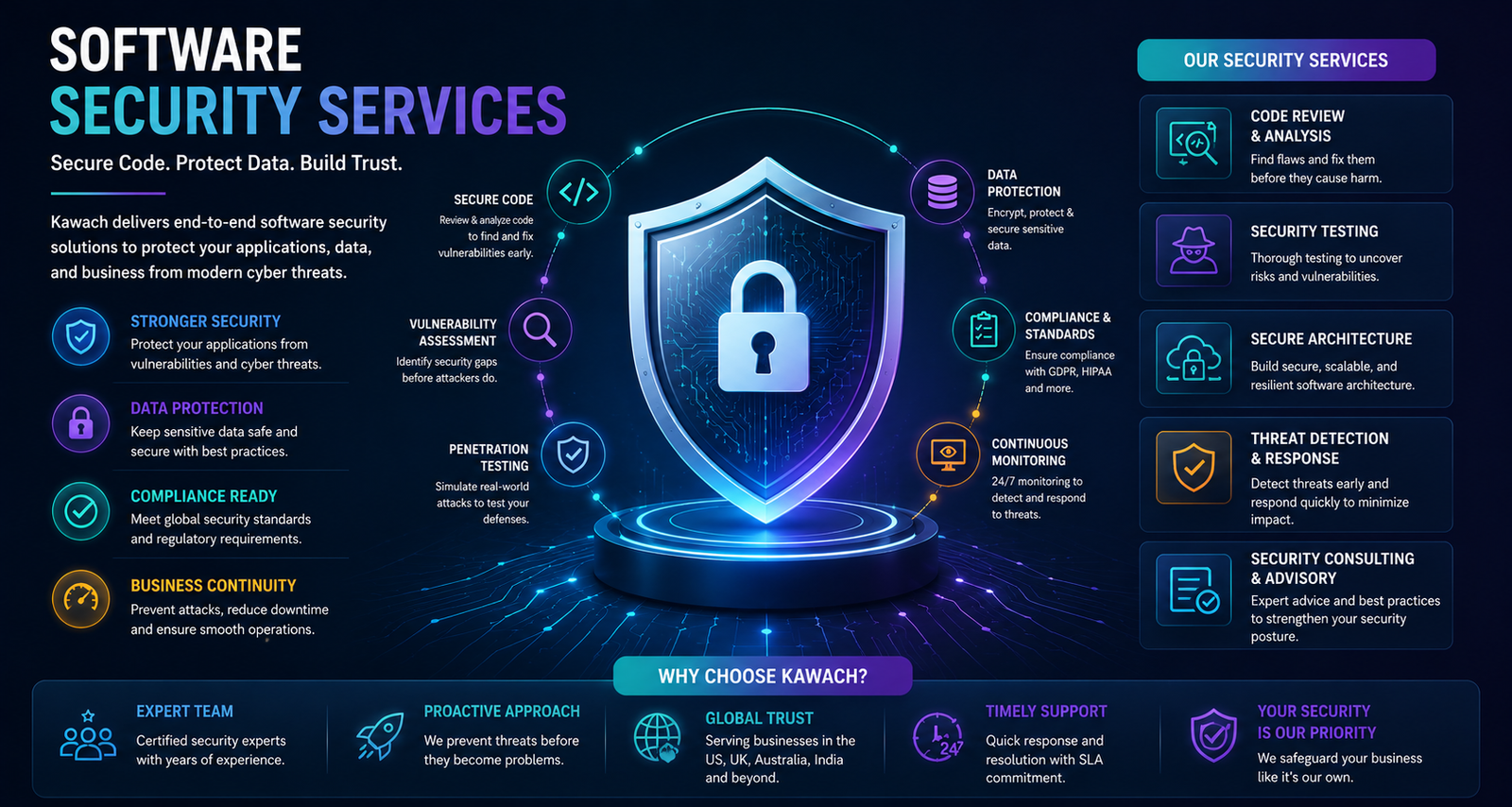
Kawach scopes security testing engagements to match the actual risk profile of the application - covering the OWASP Top 10, but going deeper on the attack surfaces that matter most for your specific application and industry. Our security testing includes authentication and session management testing, authorisation bypass attempts, injection vulnerability assessment, API security validation, and business logic testing that automated scanners consistently miss.
Technology Expertise
Test Automation Frameworks: Selenium · Playwright · Cypress · Appium · WebdriverIO · Puppeteer
API Testing: Postman · REST Assured · Karate · Hoppscotch · Newman
Performance Testing: Apache JMeter · k6 · Gatling · Locust · BlazeMeter
Security Testing: OWASP ZAP · Burp Suite · Nikto · Nmap · Metasploit · Semgrep
BDD & Test Management: Cucumber · SpecFlow · Behave · TestRail · Zephyr · Xray · Allure
Mobile Testing: Appium · Espresso · XCUITest · BrowserStack · Sauce Labs
CI/CD Integration: GitHub Actions · GitLab CI · Jenkins · CircleCI · Azure DevOps
Languages: Python · JavaScript / TypeScript · Java · C# · Ruby
Cloud & Infrastructure: AWS Device Farm · BrowserStack · LambdaTest · Docker · Kubernetes
Quality Engineering in Agile & CI/CD Environments
Quality assurance in a continuous delivery environment looks fundamentally different from waterfall testing at the end of a release cycle. Tests need to run in minutes, not hours. Feedback needs to reach developers before they have moved on to the next task. Quality needs to be a shared responsibility across the whole engineering team, not something handed off to a separate QA department at the end of a sprint.
Kawach designs quality engineering practices that work within - not against - modern delivery rhythms. Shift-left testing that moves quality activities earlier in the development cycle. Fast test suites optimised for CI/CD pipeline execution. Quality gates that block deployment automatically when critical tests fail. And the cultural practices that distribute quality ownership across the entire engineering team.
Business Benefits
Lower Cost of Defects - Bugs found in development cost a fraction of what they cost in production. A structured QA practice that shifts quality left dramatically reduces the total cost of building and maintaining software.
Faster, More Confident Releases - Comprehensive automation coverage and continuous testing remove the hesitation from the release decision. When the test suite passes, the team knows - rather than hopes - that the release is safe.
Protected User Trust - A bug that reaches production users is not just a technical failure - it is a trust event. Consistent quality engineering reduces the frequency and severity of user-facing issues that erode confidence in the product.
Compliance & Audit Readiness - Documented test plans, traceable test coverage, and structured security assessments produce the evidence that compliance frameworks require - without a scramble before every audit.
Reduced Technical Debt - A well-maintained automation suite that catches regressions prevents the slow accumulation of undiscovered bugs that make codebases increasingly fragile and expensive to change over time.
Engineering Team Efficiency - Automation that runs reliably frees QA engineers from repetitive manual testing, redirecting their attention to exploratory testing, edge cases, and quality improvement work that creates more value.
Industries We Serve
SaaS & Technology - Continuous testing integration, API test automation, multi-tenant testing strategies, and release confidence for high-frequency deployment environments
Financial Services & Fintech - Regulatory compliance validation, security testing for payment flows, performance testing for transaction systems, and audit-ready test documentation
Healthcare & Life Sciences - HIPAA-aligned testing practices, clinical software validation, accessibility testing for patient-facing applications, and rigorous regression coverage for regulated systems
E-Commerce & Retail - End-to-end checkout flow testing, payment integration validation, performance testing for peak traffic events, and cross-browser compatibility across major markets
Enterprise Software - Complex integration testing across multi-system environments, upgrade and migration validation, and long-term regression coverage for large codebases
Mobile & Consumer Applications - Cross-platform device and OS testing, real-device testing labs, usability evaluation, and performance profiling for mobile-first products
Why Engineering Teams Choose Kawach for QA
We treat quality engineering as a craft - not a commodity testing service where volume of test cases is the measure of success
Our QA engineers understand the systems they test - they read the code, understand the architecture, and design tests that reflect real risk rather than just requirement coverage
We build automation infrastructure that your team can own and maintain - not black-box tooling that creates long-term dependency
We work embedded within your engineering team rather than in a separate QA silo, which produces better outcomes and faster feedback
Every engagement includes written test strategies, documented frameworks, and findings reports that have real value beyond the engagement itself
Deep experience in regulated industries where quality failures carry legal and financial consequences beyond the technical cost
Global delivery capability with QA teams experienced in US, European, and Asia-Pacific software standards and regulatory environments
Quality Engineering for Modern Software Delivery
The role of quality engineering is evolving. AI-assisted test generation, visual regression testing, contract testing for microservices, and chaos engineering for reliability validation are moving from experimental to mainstream. Kawach stays current with these practices - not to chase trends, but because the organisations that invest in modern quality engineering genuinely ship better software, more reliably, with less overhead.
We also work with engineering leaders thinking about quality function design - how to structure a QA team, what the right balance of manual and automated testing looks like at different scales, and how to measure quality in ways that actually drive improvement rather than just producing metrics. If those are questions your organisation is working through, they are worth a conversation.
Ship Software Your Users Can Depend On
If your team is shipping more frequently than your quality processes can keep pace with - or if quality issues are regularly making it to production - a focused quality engineering engagement with Kawach is worth exploring.
We start with a quality assessment: a structured review of your current testing practices, coverage, and automation maturity that gives you a clear picture of where the gaps are and what the highest-value improvements look like. No commitments, no boilerplate proposals - just a practical conversation about what better looks like for your team.