1 0 1 1 0 0 1 0 1 1 0 1
0 0 1 0 1 0 0 1 1 0 1 0
All Services Legacy Modernization

Software Modernization Services

We modernize legacy applications in controlled stages, reducing technical debt, moving to maintainable architecture and modern hosting, without disrupting the business that depends on the existing system.

  • We buildRe-architected platforms, migrations and modern front ends
  • ForBusinesses running on ageing or hard-to-change software
  • SolvesFragile releases, slow change and unsupported technology
Free, no-obligation consultation NDA before detailed discussion You own the code on full payment
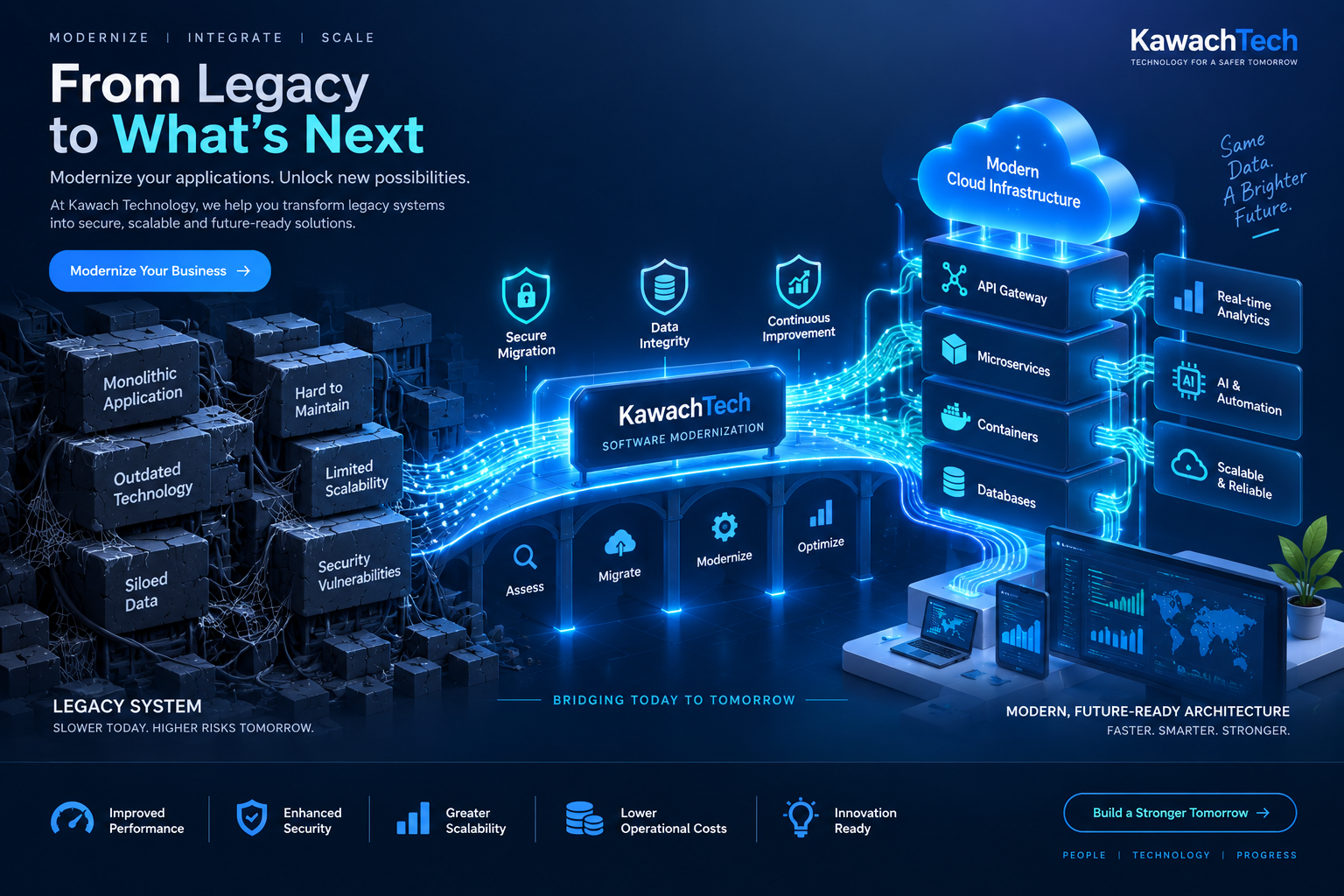
Software Modernization - Kawach Technology
200+
Projects Delivered
8+
Years in Business
50+
Team Experts
9+
Countries
98%
Satisfaction
98%
On-Time Delivery
Who We Help

Built for Teams at Different Stages

What a startup needs from Software Modernization is different from what an enterprise needs. We scope each engagement around where your business is today.

Startups

A focused first version that validates the idea quickly, built on architecture that can grow once the product finds traction.

Growing businesses

Replacing spreadsheets, manual steps and disconnected tools with software built around how the business actually runs.

Mid-market companies

Extending or integrating existing systems, adding capacity alongside an in-house team, or owning a defined module end to end.

Enterprises

Secure, well-documented systems that connect departments and legacy platforms, with clear governance and handover.

Business Problems We Solve

Where Software Modernization Makes a Difference

Most projects start with a business problem, not a technology choice. These are the situations clients most often bring to us.

Modernizing legacy applications

Replacing outdated frameworks and platforms that are hard to support or hire for.

A monolith that slows every change

Breaking the system into clear modules so teams can ship independently.

Risky, infrequent releases

Automated testing and deployment pipelines with zero-downtime releases.

Scaling an existing application

Performance and infrastructure limits that appear as usage grows.

Paper and manual processes

Digitising workflows that still depend on paper forms or email.

Integrations that keep breaking

Replacing brittle point-to-point connections with maintained APIs.

What We Build

Software Modernization Capabilities

The components we design and deliver most often, scoped to what your product actually needs.

Codebase & architecture audit

An assessment of risks, dependencies and a staged modernization plan.

Modular re-architecture

Clear service boundaries inside or around an existing monolith.

Data migration

Mapped, tested and reconciled migration from old to new systems.

Process digitisation

Replacing paper and email steps with tracked digital workflows.

Cloud migration

Moving hosting to AWS or Azure with CI/CD and monitoring.

UI modernization

New web front ends over existing back-end logic where appropriate.

Software Modernization: Overview

Software modernization means taking a system that's still functional but increasingly hard to maintain outdated technology, undocumented workarounds, a codebase nobody wants to touch and bringing it onto architecture your team can actually extend safely.

We start by understanding what the existing system actually does (including the undocumented parts), then modernize in stages rather than a risky big-bang rewrite keeping the business running throughout. Modernizing donor management for a foundation serving 220,000 donors is a real example of replacing a legacy platform without disrupting the operation depending on it.

Where a full rebuild does make sense, we scope it the same way we approach any custom software development project - phased, with the highest-risk legacy components addressed first.

Development Process

How We Deliver, Step by Step

The same six-step process runs underneath every engagement. What changes is the scope, not the discipline.

  1. 1

    Discovery

    We map your goals, users, workflows and constraints, then agree scope, priorities and a realistic timeline before development starts.

  2. 2

    Architecture

    We choose the stack, data model, integrations and hosting approach around your requirements, and document the decisions.

  3. 3

    UI/UX

    Wireframes and interface designs are reviewed with you, so the product is shaped around real user journeys before it is built.

  4. 4

    Development

    Two-week sprints with a working demo at the end of each, so you can review progress and adjust priorities as you learn.

  5. 5

    QA & Testing

    Functional, regression and cross-device testing throughout the build, not only at the end, before anything reaches production.

  6. 6

    Deployment & Support

    We release to your environment and include 30 days of post-launch support, with ongoing maintenance available afterwards.

Technology Stack

Technologies We Use for Software Modernization

Chosen per project based on your requirements, existing systems and team. These are the technologies behind our delivered work in this area.

Laravel / PHP React.js AWS Microsoft Azure Java / Spring Boot Vue.js PostgreSQL Elasticsearch
Case Studies

Relevant Projects We've Delivered

A selection of documented projects that show how we approach this kind of work. Each links to the full case study.

Property & Casualty Insurance · Chicago, Illinois, USA

Lakeshore Mutual Insurance

Business problem
Lakeshore Mutual Insurance serves more than 300,000 policyholders across the Midwest, but filing a claim in 2024 still meant picking up the phone, sending a fax, or mailing in paperwork — there was no...
Solution
We built a digital claims intake portal as the front door to everything else — policyholders can now file a claim online or via mobile in minutes, uploading photos and documentation directly rather th...
Key functionality
Digital Claims Intake PortalAutomated Triage EngineML Fraud FlaggingAdjuster Assignment & Workload Balancing
Technology
Java, Spring Boot, PostgreSQL, Python (ML), React, AWS
7 days → 4 hrsInitial Response Time
76%Digital Filing Adoption
Read the case study
Corporate Law · New York, New York, USA

Sterling & Cross Legal Partners

Business problem
Sterling & Cross Legal Partners has 140 attorneys spread across five U.S. offices, and until recently, "where is the file for this case" didn't have a reliable answer. Case documents were scattered ac...
Solution
We began with practice-group-level discovery across all five offices, since litigation, M&A, and IP practice groups each organized their case files quite differently — a single rigid taxonomy would ha...
Key functionality
Centralized Case RepositoryDocument Version ControlAutomated Time TrackingConflict-of-Interest Database
Technology
Laravel, Vue.js, PostgreSQL, Elasticsearch, AWS, DocuSign
-60%Billing Cycle Time
Days → MinutesConflict Check Time
Read the case study

View all case studies

Security & Confidentiality

How We Protect Your Project and Data

Security is handled as part of how we build, from the first discussion to deployment, not as a separate add-on.

We don't claim certifications we can't document. If your project must meet a specific standard or regulation (for example GDPR or HIPAA), we agree those requirements with you during discovery and build to them.

Secure development practices

Code review, dependency updates and secure credential handling are part of the normal build process.

Access control

Role-based permissions in the software we build, and codebase and credential access limited to the engineers assigned to your project.

Data protection

Encrypted connections, encrypted storage where the project calls for it, and data handled only for the purpose of the engagement.

Backups

Backup and restore procedures are planned as part of the hosting setup, not added after launch.

Deployment security

Separate environments, restricted production access and controlled release steps for every deployment.

Testing

Functional and regression testing throughout the build, with access and permission rules checked before release.

Confidentiality

We sign an NDA before any detailed project discussion, and custom deliverables transfer to you on full payment.

FAQ

Questions Buyers Ask About Software Modernization

Do we need to rewrite everything from scratch?

Usually not. We start with an audit, then recommend the lowest-risk path, which is often a staged approach: stabilise the current system, extract or replace modules one at a time, and retire the old parts once the new ones are proven.

Can you work on a codebase another team wrote?

Yes. Taking over and improving existing codebases is a normal part of modernization work. We document what we find, fix the highest-risk issues first and agree priorities with you.

How long does a typical project take?

It depends on scope. A focused MVP typically takes 3–6 months; a more complex platform with significant integrations can run 9–12+ months. We give a realistic timeline after the discovery phase, once we understand your actual requirements, not before.

How much will my project cost?

Cost depends on features, complexity, integrations and the engagement model. As a general reference, a focused MVP typically starts in the low five figures, a mid-sized application usually falls in the mid five figures, and a full enterprise or AI-powered platform can run into six figures. We provide a scoped estimate once we understand your requirements.

Who owns the source code and intellectual property?

You do. Under our standard terms, ownership of custom deliverables (source code, designs and related work product) transfers to you on full payment. Any pre-existing Kawach Technology tools or libraries used in the project are licensed to you for use in the delivered product. A signed SOW or agreement can set different terms.

Can you work with our existing systems and in-house team?

Yes. We regularly integrate with existing databases, CRMs, ERPs, payment gateways and third-party APIs, and we often work alongside in-house teams, either filling a specific skills gap or owning a defined module while your team owns the rest.

Which engagement models do you offer?

Fixed price for well-defined scopes, a dedicated team for ongoing product work, or time and materials when requirements are still evolving. We recommend a model based on your budget, timeline and how much day-to-day control you want.

How do you communicate with international clients?

Our engineering team is based in India. We schedule sprint planning, demos and key decisions in the working-hours overlap with your time zone, and back them up with written updates, a shared project board and a dedicated point of contact. We work with clients in the USA, UK, Germany and wider Europe.

How do you keep our project and data secure?

We sign an NDA before detailed discussions, restrict codebase and credential access to the engineers assigned to your project, and follow standard secure development practices such as access controls, encrypted storage and secure credential handling. If your project must meet a specific regulatory standard, we agree those requirements during discovery.

What happens after launch?

Every project includes 30 days of post-launch support. After that, continued assistance is available under a separate agreement, sized to what your product needs.
Have a Software Project in Mind?

Tell us what you're building, what you're trying to improve, or where your current software is falling short.

We usually respond within 24 business hours · NDA available before detailed discussion · contact@kawachtech.com